5 Best Sanders for Decks: Boards, Rails & Balusters
Affiliate disclosure: As an Amazon Associate, WoodyMan Reviews earns from qualifying purchases. If you buy through links on this page, we may earn a commission at no extra cost to you. How this works.
Short answer: for most deck refinishes, a 3x21" belt sander (the Makita 9903) does the boards and a random orbital does the edges and rails. If you'd rather buy one tool, the Bosch GET75-6N strips in turbo mode and finishes in random-orbit mode. And whatever you run on the deck boards, stop at 60-80 grit - sand finer and the stain can't soak in.
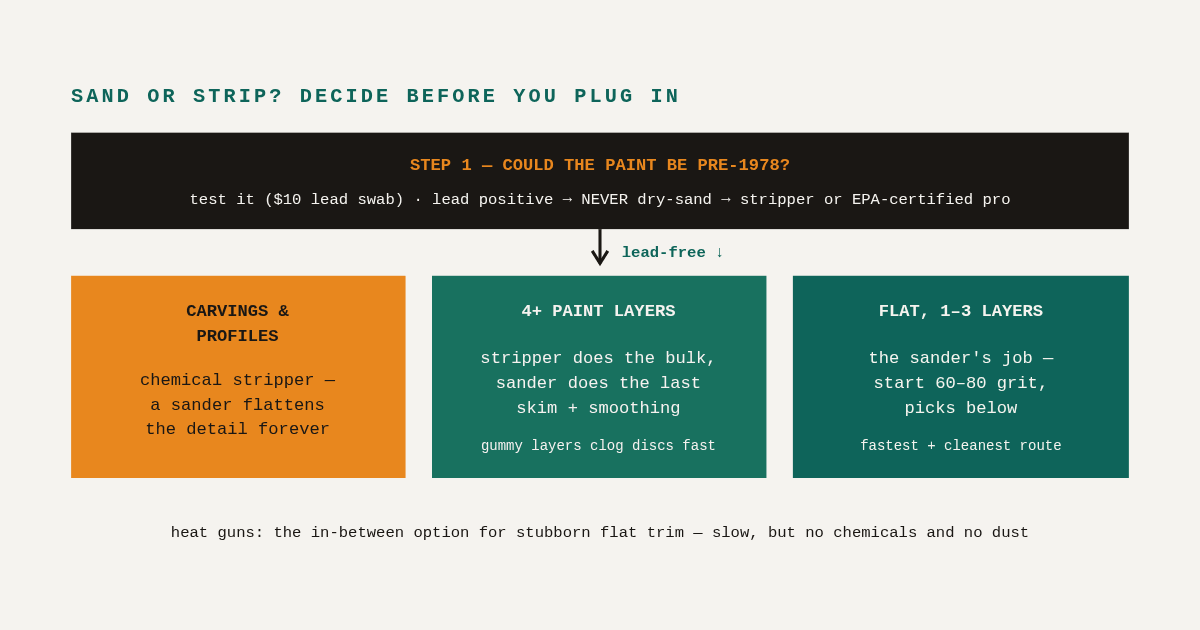
There's no single "deck sander," because a deck is really three sanding jobs in one: long flat boards (fast, aggressive tools win), board edges and ends (a palm-size orbital), and railings with balusters (a detail sander or by hand). We compared the current field on spec, pad/belt cost, dust handling, and owner-reported durability - here's what we'd buy for each job. If your deck is painted rather than stained, start with our paint-removal sander guide or a chemical stripper instead.
We earn a small commission from the Amazon links below, at no extra cost to you - see our affiliate disclosure.
The 5 best sanders for decks
| Sander | Best for | Woody Rating | |
|---|---|---|---|
| 1. Makita 9903 (belt) | Deck boards - fastest honest way to bare wood | 9.3/10 [Editor's Choice] | Check price |
| 2. Bosch GET75-6N | One tool for the whole deck - strip + finish | 9.1/10 | Check price |
| 3. DEWALT DCW210B | Cordless - no extension cord across the yard | 8.7/10 | Check price |
| 4. Bosch ROS20VSC | Budget orbital - edges, rails, small decks | 8.6/10 | Check price |
| 5. BLACK+DECKER BDEMS600 | Balusters, spindles & tight corners | 8.3/10 | Check price |
Which sander goes where
1. Makita 9903 - Editor's Choice for Deck Boards
Best for: the main event - hundreds of square feet of weathered board, done in an afternoon instead of a weekend.
A deck board is a long, straight, rough plank; that's belt-sander territory, and the 9903 is the belt sander we recommend across our woodworking and paint-removal guides for the same reasons: an 8.8-amp motor that holds speed under load, auto-tracking so the belt doesn't walk off mid-pass, and variable speed (690-1,440 ft/min) so you can slow down on softwood decking before you dig a trench. Run it along the boards with 40-grit to cut back the gray, then a 60-80 pass, and you're stain-ready. It's quiet for a belt sander, and belts are cheap in bulk.
| Pros | Cons |
|---|---|
| ✅ Fastest realistic route through weathered decking | ❌ Overkill for a small landing or stairs alone |
| ✅ Auto-tracking belt, variable speed | ❌ Can gouge soft decking if you stall on one spot |
| ✅ Belts are cheap; 3x21" is the standard size | ❌ Dust bag is token - wear a respirator |
2. Bosch GET75-6N - One Tool for the Whole Deck
Best for: buying a single sander that strips boards and finishes rails - and still earns its keep indoors afterward.
The GET75-6N is a 6", 7.5-amp random orbital with a second, "turbo" eccentric mode that removes stock at a rate closer to a belt sander - Bosch claims up to 5× the normal orbit mode, and owner reports back it up on decking. Turbo mode with 40-grit flattens weathered boards; flip to random-orbit mode with 80 and the same tool does edges, ends, and the top rail without swirl marks. It's heavy (5.7 lb) - on a deck that works for you, since the weight does the pressing. If the deck is the first job of many, this is the most sander per dollar on the list.
| Pros | Cons |
|---|---|
| ✅ Turbo mode genuinely replaces a belt sander on decking | ❌ Heavy for vertical or overhead work |
| ✅ Strips and finishes with one tool | ❌ Costs as much as two single-purpose tools |
| ✅ 6" pads cover ground quickly | ❌ Needs a vac hose to control dust properly |
3. DEWALT DCW210B - Best Cordless
Best for: decks that are a long way from an outlet - and the railing work where a cord is constantly hooked on a baluster.
Sanding a deck with a corded tool means an extension cord across the lawn and a plug that pops loose every third pass. The DCW210B is a 5" random orbital on DeWalt's 20V MAX platform with a brushless motor and variable speed (8,000-12,000 OPM), and it's the pick we recommend for ladder-and-railing work in our exterior guide for the same reason it wins here: nothing to snag. Budget honestly for batteries - aggressive low-grit deck work eats a 5Ah pack in well under an hour, so this is the "already on DeWalt batteries" pick (it's a bare tool) or the secondary sander for rails while a corded tool does boards.
| Pros | Cons |
|---|---|
| ✅ No cord across the yard or hooked on balusters | ❌ Bare tool - battery and charger extra |
| ✅ Brushless, variable speed | ❌ Battery runtime is the real limit on big decks |
| ✅ Standard 5" hook-and-loop discs |
4. Bosch ROS20VSC - Best Budget Orbital
Best for: small decks, stair treads, and the edge-and-rail pass on any deck - at half the price of the fancy options.
The ROS20VSC is our standing budget-orbital recommendation, and a deck doesn't change the math: 2.5 amps, variable speed, Bosch's pad-dampening system that keeps swirls out of the finish pass, and a dust canister with a real microfilter. On weathered boards it's slow at stock removal - it's the wrong primary tool for a 400 sq ft deck - but for a landing, a small platform deck, or the detail pass behind a belt sander, it's all the sander the job needs.
| Pros | Cons |
|---|---|
| ✅ Proven, cheap, uses standard 5" discs | ❌ Slow on heavily weathered boards |
| ✅ Genuinely useful dust canister | ❌ Corded - cord management on rails is a chore |
| ✅ Swirl-free enough for the visible top rail |
5. BLACK+DECKER BDEMS600 - Balusters & Corners
Best for: the part everyone dreads - dozens of balusters, the corners where rail meets post, and the trim a round pad can't touch.
No large sander fits between balusters. The BDEMS600 mouse sander's pointed pad does, and its three-position grip lets you choke up on it like a sanding block for spindle-by-spindle work - our how-to-use guide covers the technique. It won't strip a deck board (wrong tool, don't try), but paired with any of the board sanders above it completes the kit for under $40. Foam hand pads finish the rounded baluster faces the flat pad can't follow.
| Pros | Cons |
|---|---|
| ✅ Only tool style that fits between balusters | ❌ Useless on deck boards - detail work only |
| ✅ Cheap; pads universally available | ❌ Corded, and rails are exactly where cords snag |
| ✅ Detail-finger attachment for rail-post corners |
Deck sanding, in the right order
Wash first, sand dry. Clean the deck (deck wash or a careful low-pressure rinse), then give it at least 48 hours of dry weather before sanding. Wet fibers clog paper instantly and sand fuzzy.
Set nails and screws below the surface. One proud screw head shreds a $2 belt in seconds. Walk the deck with a driver first.
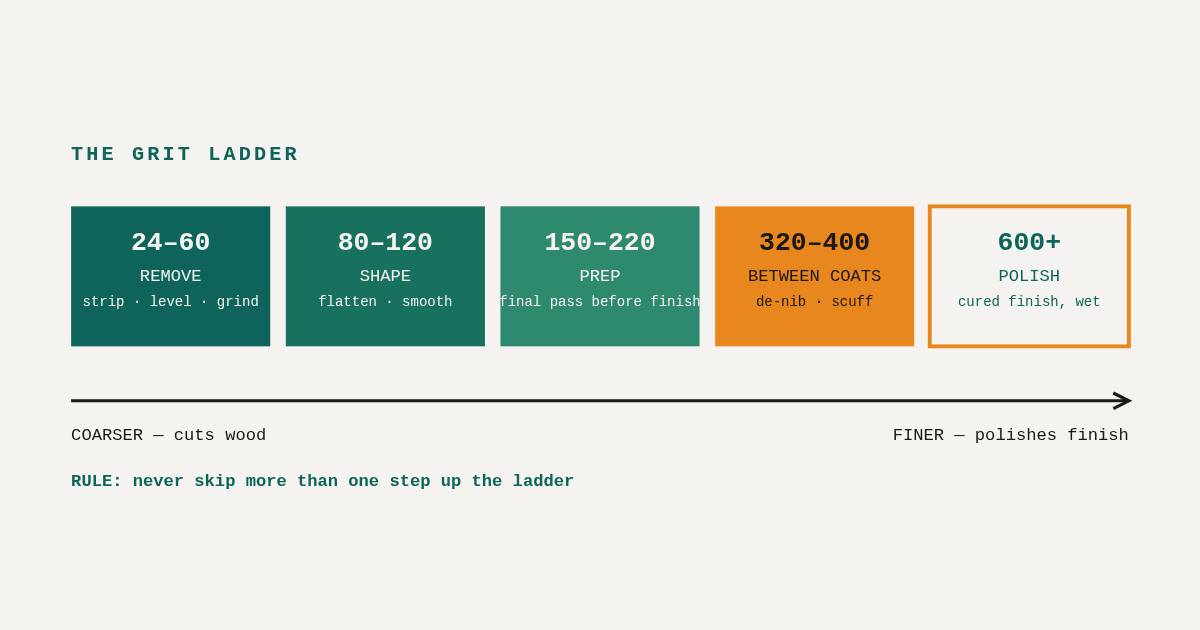
Boards: coarse, along the grain, keep moving. 36-40 grit to cut the gray back to bright wood, then one pass at 60-80. Always along the boards. A belt sander parked in one spot for two seconds leaves a dip you'll see after staining.
Stop at 80 grit - really. Decking isn't furniture. Past 80 the surface burnishes, and penetrating stain sits on top instead of soaking in - the number-one cause of a stain job that peels in a year. Our sandpaper grit chart covers the full progression logic; deck boards are the rare case where "finer" is worse.
Then stain within the window. Freshly sanded wood is thirstiest in the first days after sanding. Pick your product with our oil vs water-based deck stain comparison (or the paint-or-stain decision guide if you're not committed), check dry-time expectations against the forecast, and see our oil-based stain picks for specific products.
Frequently asked questions
What grit sandpaper is best for a deck? Start at 36-40 on weathered or previously stained boards, finish at 60-80. Railings can go to 100 since hands touch them. Never finer than 80 on the walking surface - stain needs open pores to penetrate.
Should I rent a drum floor sander for my deck? Usually no. Drum sanders need a dead-flat floor; deck boards cup, crown, and sit proud of each other, so a drum rides the high spots and gouges. Rental orbital deck sanders (large multi-disc machines) work but cost $60-100/day - two days' rent buys the Makita.
Can I just power-wash instead of sanding? Washing removes dirt and failed finish but raises the grain - the deck feels furry once dry. If you wash, plan on at least a light 60-80 grit pass after. High pressure held close also chews soft spring wood permanently; keep the fan tip moving and 12"+ away.
Do I need to sand a new deck before staining? Light sanding helps: new pressure-treated lumber ships with "mill glaze" that repels stain. A quick 60-80 pass (after the wood passes the water-drop absorption test) opens the surface. Full-depth sanding isn't needed.
How long does sanding a deck take? With a belt sander or 6" turbo orbital, plan roughly an hour per 100 sq ft of boards, plus as long again for edges and railings - balusters are slow. A 300 sq ft deck with rails is a full day of actual sanding.
Verdict
Match the tool to the deck: Makita 9903 if the deck is mostly boards and you want it done fast; Bosch GET75-6N if you want one tool that strips boards and finishes rails (and does furniture next winter); DCW210B if you're on DeWalt batteries or the outlet is 80 feet away. Add the BDEMS600 if you have balusters - your knuckles will thank you. And whatever you run: stop at 80 grit, then get the stain on.