6 Best Mouse Sanders: Small Pads, Tight Corners, No Excuses
Affiliate disclosure: As an Amazon Associate, WoodyMan Reviews earns from qualifying purchases. If you buy through links on this page, we may earn a commission at no extra cost to you. How this works.
A mouse sander does one job the bigger tools can't: its pointed, iron-shaped pad reaches into corners, between chair spindles, and along mouldings - the places a random orbital just rounds over. It's the furniture-refinisher's tool.
A quick note on this update: the mouse-sander shelf changed a lot in the last few years. Several once-popular brands (TECCPO, TACKLIFE, Meterk) vanished from Amazon entirely, and Milwaukee entered the category with the first genuinely premium option. We've rebuilt this list around what you can actually buy today.
We earn a small commission from the Amazon links below, at no extra cost to you - see our affiliate disclosure. Rankings are built from spec comparison, pad-ecosystem cost, and patterns across thousands of owner reviews - not hands-on lab tests; how we review.
The 6 best mouse sanders
| Mouse Sander | Best for | Woody Rating | |
|---|---|---|---|
| 1. BLACK+DECKER BDEMS600 | The definitive mouse - best for most people | 9.3/10 [Editor's Choice] | Check price |
| 2. Milwaukee M12 FUEL Detail | Premium cordless - swirl-free finish | 9.1/10 | Check price |
| 3. WEN 6301 | Best budget buy | 8.6/10 | Check price |
| 4. Hammerhead HADS014 | Most complete kit for the money | 8.4/10 | Check price |
| 5. Genesis GPS080 | Smallest grip - delicate work | 8.2/10 | Check price |
| 6. BLACK+DECKER BDEMS200C | Cheapest way into the category | 8.0/10 | Check price |
1. BLACK+DECKER BDEMS600 - Editor's Choice
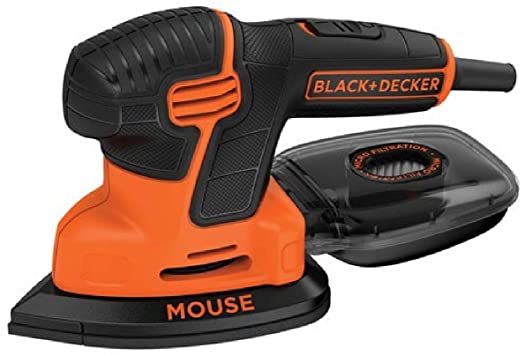
Best for: most people, most of the time - B+D invented the "Mouse" and this is the version everyone else copies.
1.2 amps and 16,000 OPM in a body you can steer with your fingertips. The three-position grip is the feature that matters in practice: palm on top for panels, thumb-forward for edges, precision grip for the tightest spots. The snap-on detail finger reaches where even the standard nose can't, and the micro-filtration canister actually collects dust rather than decorating your forearm with it. Pads are hook-and-loop, cheap, and every third-party pad maker supports the Mouse shape. Nothing exotic - just the most refined version of the tool.
| Pros | Cons |
|---|---|
| ✅ 3-position grip genuinely changes control | ❌ Corded - the cable snags in tight interior work |
| ✅ Detail finger attachment for extreme corners | ❌ Vibrates at the tip under pressure (all mice do) |
| ✅ Cheap, universally available pads | |
| ✅ Effective micro-filtration dust canister |
2. Milwaukee M12 FUEL Orbital Detail Sander - Premium Pick
Best for: anyone already on the M12 battery platform, and anyone tired of the swirl scratches vibrating pads leave in stain-grade work.
Here's the technical difference that justifies the price: cheap mouse sanders vibrate their pad, which scrubs micro-swirls into the surface that only show up after you stain. Milwaukee's brushless M12 FUEL unit runs a true 1.5mm orbital action - the same motion as a random orbital, shrunk to a detail pad - and leaves a stain-grade surface right into the corners. Cordless, genuinely powerful, ships with mesh sheets and a pad saver. The catch is the M12 tax: it's a bare tool, so add a battery and charger (or buy the kit with battery). Worth it if this isn't your last Milwaukee - see our M18 vs M18 Fuel explainer for how Milwaukee's FUEL branding works.
| Pros | Cons |
|---|---|
| ✅ True orbital action - no vibration swirls | ❌ Bare tool; battery/charger extra |
| ✅ Cordless freedom inside cabinets/furniture | ❌ 3-4× the price of the B+D |
| ✅ Brushless motor, mesh-sheet compatible |
3. WEN 6301 - Best Budget
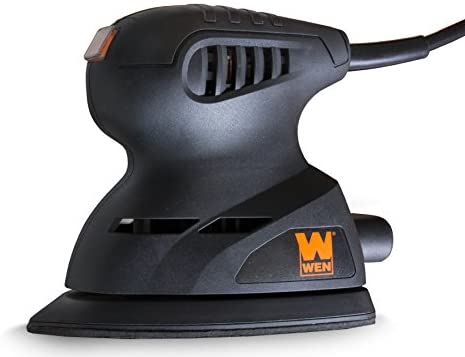
Best for: occasional users and one-project buyers - the least money that buys a genuinely usable mouse sander.
WEN's whole business is "the cheap tool that's actually fine," and the 6301 delivers: 1 amp, 13,500 OPM, two pounds, with a vacuum adapter most budget mice skip. The pad is a slightly different 3.75x5.5" shape, so buy WEN's own pads or check compatibility before ordering third-party packs. Power is modest - it politely refuses aggressive stock removal - but for refreshing furniture, window sills and craft work it does the job for the price of a decent lunch out.
| Pros | Cons |
|---|---|
| ✅ Unbeatable price | ❌ Modest power - light work only |
| ✅ 2 lb - zero fatigue | ❌ Non-standard pad size |
| ✅ Vacuum adapter at this price is rare |
4. Hammerhead HADS014 - Best Kit Value
Best for: starting from zero - sander, detail attachment and 12 sheets of sandpaper in one box.
The Hammerhead is the "everything included" pick: 1.4 amps (the strongest motor of the budget group), a detachable detail-finger attachment like the B+D's, dust collection, and a dozen assorted-grit sheets so you can start sanding the day it arrives. Fit and finish sit a step below Black+Decker - the pad velcro wears faster - but as a complete starter package it's the best value on the list.
| Pros | Cons |
|---|---|
| ✅ Strongest budget motor (1.4 A) | ❌ Pad velcro wears faster than B+D's |
| ✅ 12 sheets + detail attachment included | |
| ✅ Dust collection included |
5. Genesis GPS080 - Smallest Grip
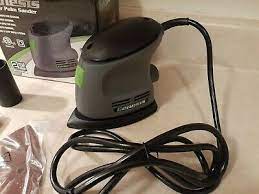
Best for: small hands and delicate work - the lowest-profile grip of any mouse here, plus a dust-proof switch that outlives the usual failure point.
The GPS080 sits lower in the palm than anything else on this list, which translates to more feel and less fatigue on long detail sessions - refinishing a staircase's worth of balusters, say. The dust-proof power switch addresses the thing that actually kills cheap sanders (grit getting into the switch), and there's a vacuum port. It's not powerful and doesn't pretend to be; it's the scalpel of the group.
| Pros | Cons |
|---|---|
| ✅ Lowest, most controllable grip | ❌ Least powerful pick here |
| ✅ Dust-proof switch - kills the usual failure mode | |
| ✅ Vacuum port |
6. BLACK+DECKER BDEMS200C - Cheapest Entry
Best for: a drawer tool - the least you can spend and still get the genuine Mouse pad shape and its pad ecosystem.
The BDEMS200C is the stripped-down Mouse: same 1.2-amp class and same pad compatibility as the BDEMS600, minus the three-position grip and the nicer dust canister. If the WEN's non-standard pads put you off and the 600 feels like overkill for occasional touch-ups, this is the sensible floor for the category. Spend the difference on a good pad assortment.
| Pros | Cons |
|---|---|
| ✅ Genuine Mouse pad shape/ecosystem, minimum price | ❌ Basic grip, basic dust box |
| ✅ Same 1.2 A class as the 600 |
Mouse sander buying guide: what actually matters
Vibrating vs orbital. Every mouse under $60 vibrates its pad; only the Milwaukee truly orbits. Vibration is fine for paint prep and general smoothing, but it leaves micro-swirls you'll see under stain - if your end product is stained furniture, that's the argument for the M12 (or finishing by hand with the grain).
Pad shape = running cost. The B+D "Mouse" triangle is the de-facto standard with dirt-cheap third-party pads. WEN and some others use their own sizes - check pad price and availability before you buy the tool, because you'll spend more on pads than on the sander over its life.
Dust collection is a health feature. Sanding dust is the worst part of the job. A canister is good; a vacuum port you actually connect is better. Our wood sanders pillar guide has the full dust rundown.
A mouse is a second sander. It finishes what a bigger tool starts. For panels and tabletops you still want a random orbital - our best sanders for woodworking covers those - and for the closely related category, compare with our detail sanders guide.
Frequently asked questions
What is a mouse sander used for? Detail work a bigger sander can't reach: corners of panel doors and drawer fronts, chair spindles and stair balusters, window sills and muntins, mouldings, and paint prep in tight interior spots. The pointed pad gets flat into 90° corners - that's the whole reason the shape exists. What it's not for: table tops, doors, or anything measured in square feet.
Is a mouse sander the same as a detail sander? Effectively yes - "Mouse" is Black+Decker's trademark that became the generic name, the way Hoover did. "Detail sander" is the neutral term; both mean a small triangular-pad finishing sander.
What grit should I use? 80 for paint removal and shaping, 120 for general smoothing, 180-240 before finish. Buy an assortment pack; mouse pads are cheap and clog fast at low grits.
Can a mouse sander replace a regular sander? No - the pad is too small to keep flat surfaces flat; you'll dig hollows. Use it for corners, edges, profiles and touch-ups, and a sheet sander or orbital for anything bigger than a hand's width.
Why did my mouse sander's pads stop sticking? The hook-and-loop face wears out - friction heat melts the hooks. A "pad saver" (thin sacrificial layer) extends its life; on the B+D and Genesis you can replace the base pad itself for a few dollars.
Verdict
The BDEMS600 is still the answer for 9 buyers in 10. Go Milwaukee M12 the day swirl marks in stained work start costing you re-dos (or you're on M12 batteries already). Go WEN if the budget is the budget. Whichever you buy, spend $15 more on a big grit assortment - running the right grit matters more than which mouse is holding it.