Best Sheet Sanders: 5 Finishing Sanders for Flat Surfaces and Corners
Affiliate disclosure: As an Amazon Associate, WoodyMan Reviews earns from qualifying purchases. If you buy through links on this page, we may earn a commission at no extra cost to you. How this works.

A sheet sander - the flat, rectangular-pad "finishing" or palm sander - earns its place for two reasons a random orbital can't match: its square pad reaches right into inside corners and flush against a raised edge, and it runs on ordinary sandpaper you cut yourself, so consumables cost pennies instead of the price of hook-and-loop discs. The trade-off is that its fixed orbital motion removes material slowly and can leave faint swirls under stain, so it's a finishing tool, not a stock-remover.
Two things to know before you pick one:
- Quarter-sheet vs. third-sheet. A 1/4-sheet sander is small, light, and one-handed - the most popular size. A 1/3-sheet covers more area per pass for bigger flat panels, at more weight.
- Paper clamps vs. hook-and-loop. Classic sheet sanders clamp a cut piece of standard sandpaper (cheapest). Some also take pre-punched hook-and-loop paper for convenience - handy, but that paper costs more.
The five below are the finishing sanders worth buying, from the everyday quarter-sheet to a cordless option and a value third-sheet.
We earn a small commission from the Amazon links below, at no extra cost to you - see our affiliate disclosure.
The 5 best sheet sanders
| Sheet Sander | Best for | Woody Rating | |
|---|---|---|---|
| 1. DEWALT DWE6411K 1/4-Sheet | Best overall quarter-sheet | 9.2/10 [Editor's Choice] | Check price |
| 2. Makita BO4556K 1/4-Sheet | Smoothest, lowest vibration | 9.0/10 | Check price |
| 3. Bosch GSS20-40 1/4-Sheet | Best dust collection | 8.8/10 | Check price |
| 4. DEWALT DCW200B 20V (bare) | Best cordless | 8.6/10 | Check price |
| 5. WEN 6313 1/3-Sheet | Best value / big panels | 8.2/10 | Check price |
1. DEWALT DWE6411K 1/4-Sheet - Editor's Choice
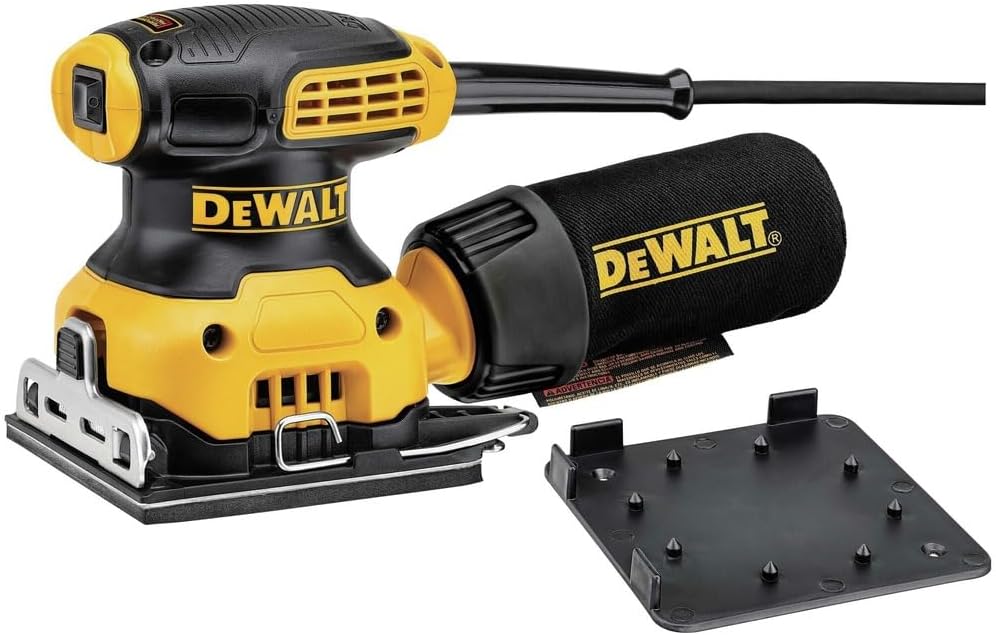
Best for: the everyday finishing sander most people should buy - flat panels, trim, and corners.
The DWE6411K is the quarter-sheet sander to beat. A 2.3-amp motor at 14,000 OPM gives it enough bite to actually get work done, and DEWALT's separate counterweight noticeably cuts the buzzy vibration these sanders are known for, so your hand doesn't go numb on a long session. It takes both clamped standard sandpaper and pre-punched hook-and-loop, so you can run cheap paper for big jobs or convenient discs for quick ones. The rubber overmold grip and a short, close-to-the-work profile make it easy to control into corners, and the locking dust bag is a step up from most. It ships as a kit with the bag. For 90% of finishing tasks, this is the right tool.
| Pros | Cons |
|---|---|
| ✅ Strong 14,000 OPM, low vibration | ❌ Fixed orbit - light finish work, not hogging |
| ✅ Takes clamped paper AND hook-and-loop | ❌ Corded |
| ✅ Gets into corners; comfortable grip | |
| ✅ Decent locking dust bag |
2. Makita BO4556K 1/4-Sheet - Smoothest, Lowest Vibration
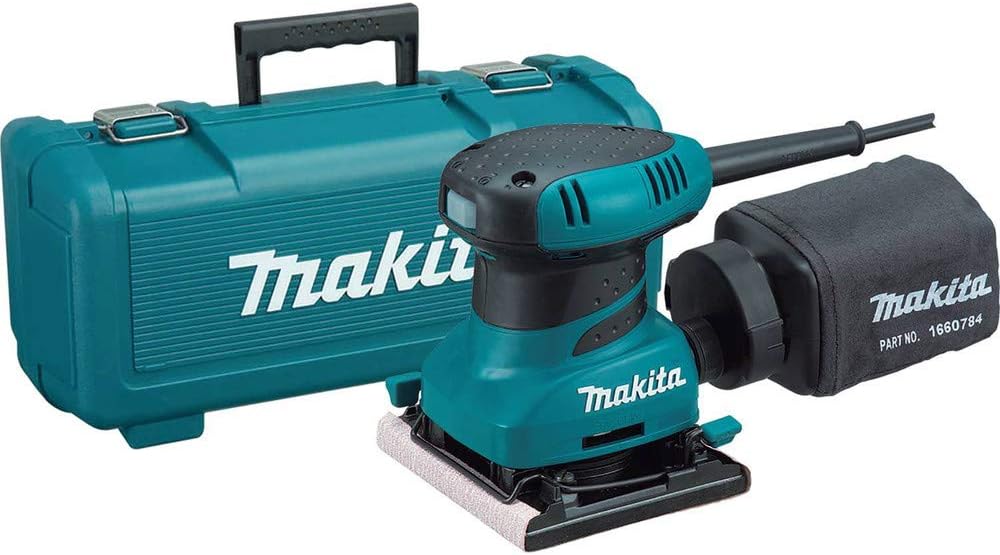
Best for: long finishing sessions where comfort and a fine surface matter most.
Makita's BO4556K is the refinement pick. It's light (about 2.5 lbs), and its balance plus a well-damped 14,000-OPM motor make it the smoothest-running sander here - the kind of tool you can hold all afternoon without buzzing hands. The clamp system takes standard 1/4-sheet paper, and there's a through-the-pad dust path to a bag. It's slightly less aggressive than the DEWALT and it's a clamp-paper design (no hook-and-loop option), but for pure fine finishing and comfort it's arguably the nicest in the hand. Comes with a case. A great choice for furniture and cabinet work where surface quality is everything.
| Pros | Cons |
|---|---|
| ✅ Smoothest, lowest-vibration here | ❌ Clamp paper only (no hook-and-loop) |
| ✅ Light and well balanced | ❌ Slightly less aggressive |
| ✅ Fine, consistent finish | |
| ✅ Includes case |
3. Bosch GSS20-40 1/4-Sheet - Best Dust Collection
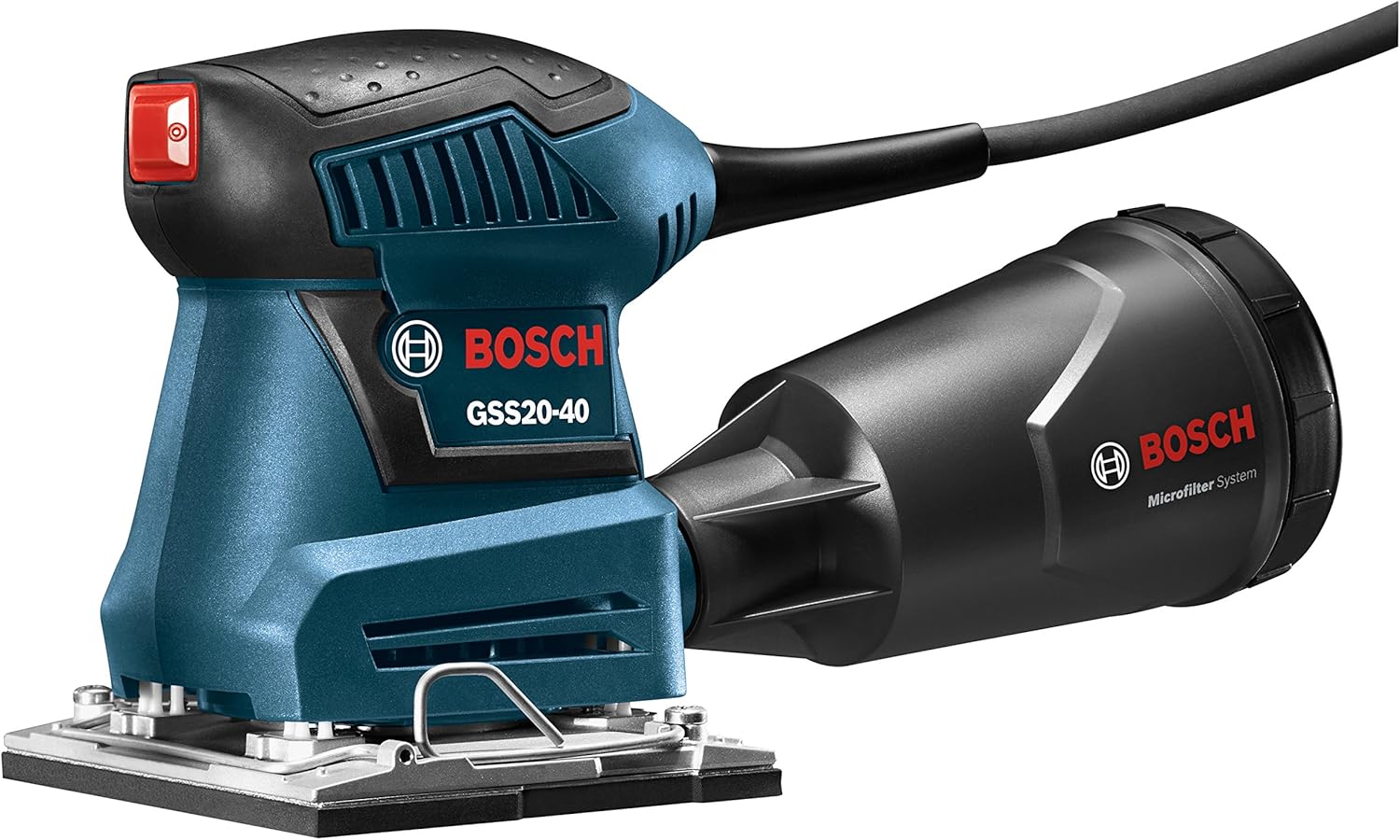
Best for: working indoors or anyone who hates cleaning up sanding dust.
Sheet sanders throw a lot of fine dust, and the GSS20-40 manages it best. A precision aluminum sanding plate with a micro-filter dust canister pulls fine dust through the pad and traps it cleanly, so you see less haze in the air and less on the work. The aluminum plate also stays flatter than plastic over time, which helps it sand evenly. It runs at 12,000 OPM - a touch slower than the DEWALT and Makita, trading a little speed for control and that class-leading dust capture. If your shop is a corner of the house, this is the considerate choice.
| Pros | Cons |
|---|---|
| ✅ Best-in-class dust capture | ❌ Slightly slower at 12,000 OPM |
| ✅ Flat aluminum plate sands evenly | ❌ Corded |
| ✅ Micro-filter canister |
4. DEWALT DCW200B 20V - Best Cordless
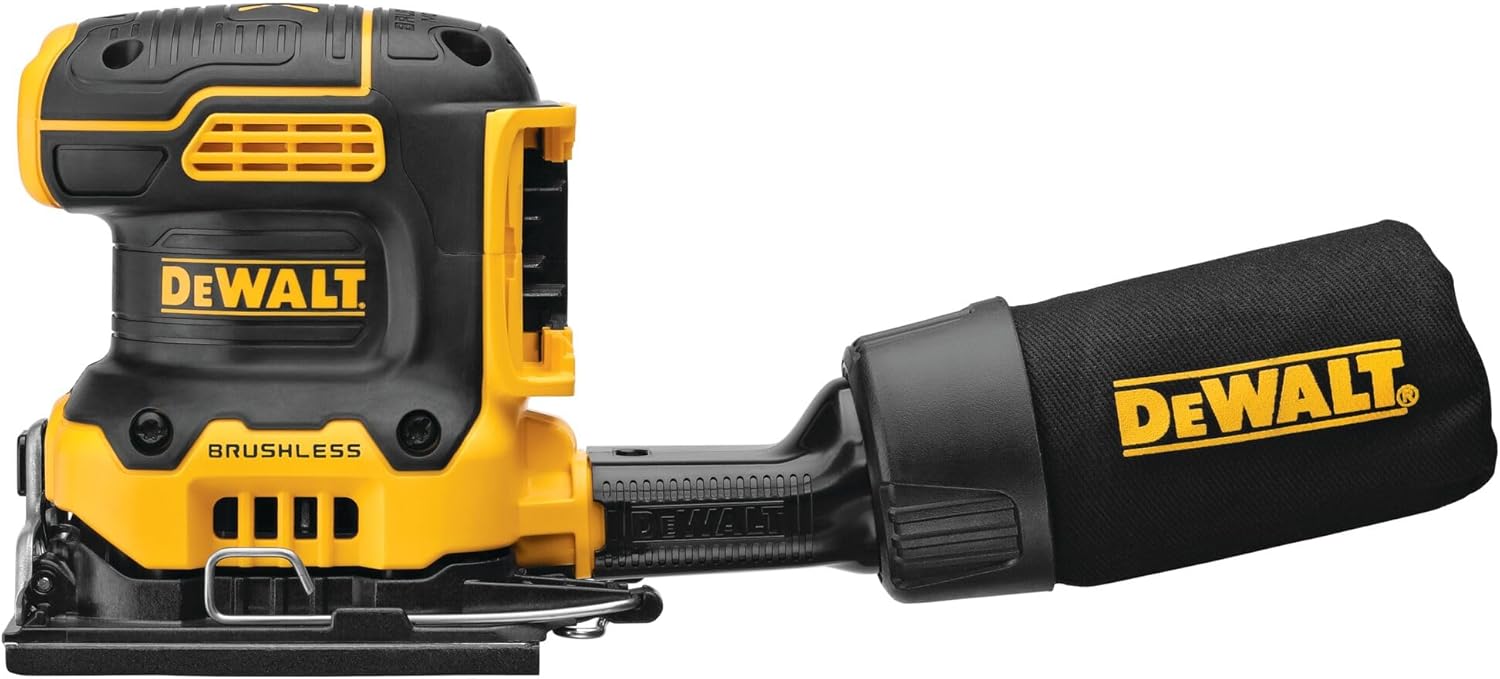
Best for: finishing work away from an outlet, and anyone already on the DEWALT 20V platform.
Dragging a cord around a piece you're finishing is a nuisance, and the DCW200B cuts it loose. It's a 20V variable-speed 1/4-sheet sander (8,000-14,000 OPM) that runs off DEWALT's 20V MAX batteries, so it's a natural add if you already own the platform. Variable speed lets you dial down for delicate finish passes, and it takes the same clamped or hook-and-loop paper as its corded sibling. It's sold as a bare tool, so factor in a battery and charger if you don't have them. For on-site trim, furniture in the driveway, or just cord-free convenience, it's the pick.
| Pros | Cons |
|---|---|
| ✅ Cordless, variable speed | ❌ Bare tool - battery/charger extra |
| ✅ Runs on DEWALT 20V MAX | ❌ Runtime limited on big jobs |
| ✅ Takes clamped or hook-and-loop paper |
5. WEN 6313 1/3-Sheet - Best Value / Big Panels
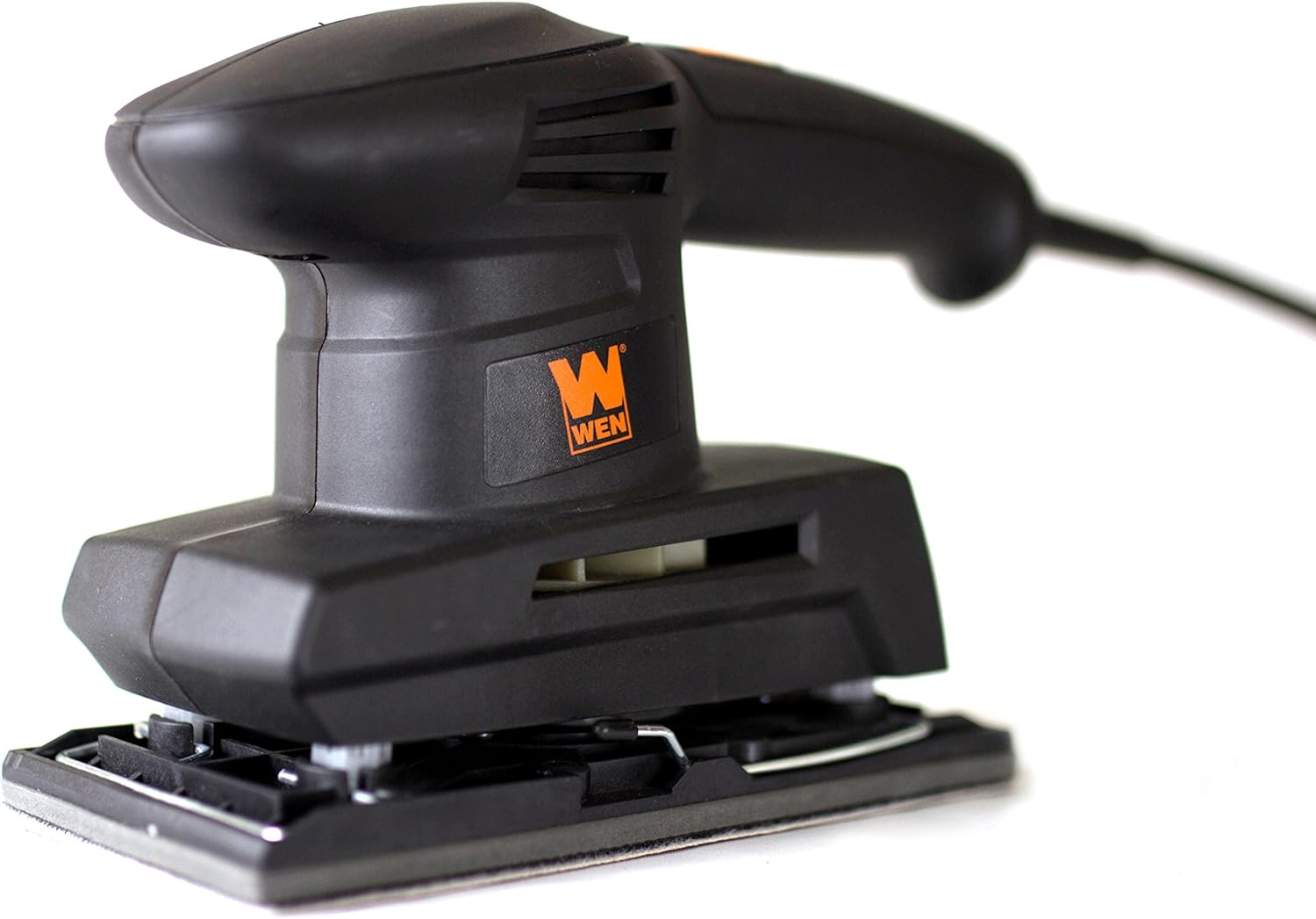
Best for: covering larger flat panels quickly, on a budget.
If most of your sanding is bigger flat surfaces - tabletops, doors, cabinet sides - a 1/3-sheet sander covers more ground per pass than a quarter-sheet, and the WEN 6313 delivers that for the least money. It clamps standard third-sheet paper, has a simple dust port, and moves across a panel noticeably faster thanks to the larger pad. It's less refined than the DEWALT or Makita and a bit more of a handful in tight spots, but for the money it's a lot of finishing coverage. A sensible pick for a homeowner tackling a big refinishing job rather than fine detail.
| Pros | Cons |
|---|---|
| ✅ Bigger pad covers panels faster | ❌ Bulkier in tight spots |
| ✅ Cheapest here; cheap paper | ❌ Less refined finish |
| ✅ Simple, dependable |
Sheet sander vs. random orbital - which do you need?
They look similar but do different things:
- A sheet sander has a rectangular pad and a small fixed orbit. It gets into square inside corners and flush to edges, runs on cheap cut sandpaper, and is best for light finishing and paint prep. Its fixed pattern can leave faint swirls under stain.
- A random orbital has a round pad that spins and orbits randomly, so it leaves no swirl pattern and removes material faster - but the round pad can't reach into a corner, and it uses pricier hook-and-loop discs.
Many shops own both: the random orbital for fast, swirl-free work on open surfaces, and the sheet sander for corners, edges, and final finishing. See the fuller comparison in our belt vs orbital explainer and the wood sanders hub.
How to choose a sheet sander
- Size: 1/4-sheet for control, corners, and one-handed comfort; 1/3-sheet for covering big flat panels faster.
- Paper system: clamp-style takes cheap standard sandpaper you cut down; hook-and-loop is faster to change but costs more. Some (like the DEWALT) do both.
- Vibration & comfort: a counterweight and good grip matter a lot on a tool you hold for long finishing sessions - the Makita and DEWALT lead here.
- Dust collection: an onboard micro-filter (Bosch) or a shop-vac port keeps fine dust down, especially indoors.
- Corded vs. cordless: cordless (DCW200B) frees you from an outlet; corded gives unlimited runtime for less.
Frequently Asked Questions
What is a sheet sander used for?
Light finishing and paint prep on flat surfaces, and getting into square inside corners and flush against edges - thanks to its rectangular pad. It's a finishing tool, not a heavy stock-remover; for fast material removal use a belt or random orbital sander.
Sheet sander or random orbital sander - which is better?
Neither is "better" - they're different. A random orbital removes material faster and leaves no swirls but can't reach corners; a sheet sander reaches corners and uses cheap paper but works more slowly. For corners, edges, and final finishing, choose a sheet sander; for open surfaces and speed, a random orbital.
Can I use regular sandpaper in a sheet sander?
Yes - that's a big advantage. Clamp-style sheet sanders take a cut piece of ordinary sandpaper (a quarter or third of a standard sheet), which is far cheaper than hook-and-loop discs. Just match the sheet size to your sander.
Why does my sheet sander leave swirl marks?
Its fixed orbital pattern can leave faint swirls, especially under stain. Minimize them by not skipping grits, keeping the sander moving, using light pressure, and finishing with a fine grit (220+). For truly swirl-free results on open surfaces, a random orbital is better.
More in the sanders cluster
Compare every type in the wood sanders hub. For corners and detail beyond what a sheet pad reaches, see detail sanders and mouse sanders; for doors specifically, our best sanders for doors guide; and for a general all-rounder, the best sander for woodworking.