Belt Sander vs Orbital Sander: Which One Do You Actually Need?
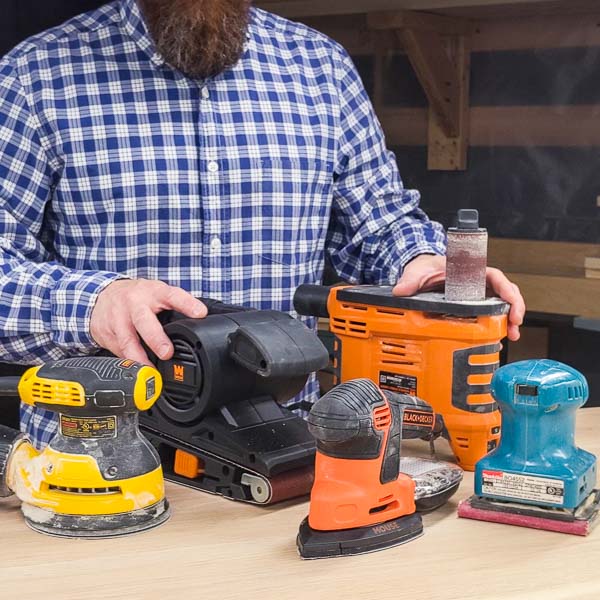
The short answer: these are not competing tools. A belt sander is for removing material fast - flattening, leveling, stripping old finish. An orbital sander is for finishing - the smooth, swirl-free surface you touch before paint or oil goes on. Most woodworkers who own both reach for them at different stages of the same project.
But if you're only buying one, the answer is almost always the random orbital sander. Below is why, and where that rule breaks.
Belt vs orbital at a glance
| Belt sander | Random orbital sander | |
|---|---|---|
| Action | Continuous abrasive loop driven over two drums - a linear, one-direction cut | Round pad that spins and oscillates in overlapping ellipses |
| Job | Aggressive stock removal: flattening panels, leveling edge-glued boards, stripping paint | Fine surface prep: 120-grit up to 220+, ready for finish |
| Speed rating | Feet per minute of belt travel (roughly 900-1,600 SFPM) | Orbits per minute (roughly 7,000-12,000 OPM) |
| Typical grits | 40-120 | 80-240 |
| Marks left | Straight scratches - must run with the grain | Faint random scratch pattern, invisible under finish |
| Learning curve | Real: it can gouge a workpiece in one second of inattention | Nearly none |
| Buy first? | Only if your work is stock removal | Yes, for almost everyone |
How each tool actually works
A belt sander stretches a loop of abrasive around two drums (front idler, rear drive) and runs it in one direction, like a tank tread. All the cutting force goes one way, which is why it hogs off material so quickly - and why it leaves straight scratches that show through stain if you run it across the grain. Handheld belt sanders are sized by belt: 3x18", 3x21" (the sweet spot), and 4x24".
A random orbital sander spins a round hook-and-loop disc while simultaneously moving it in small eccentric orbits. Because the pad never travels the same path twice, the scratch pattern is random and doesn't read as lines under paint or oil. This is the tool the general-purpose sander guide recommends as the one sander every shop needs.
One naming trap: a plain "orbital sander" (the square quarter-sheet sheet sander) only vibrates in tiny circles - it's gentler, cheaper to feed, but will leave visible swirl marks if you linger. "Random orbital" is the one with the round pad and the swirl-free result. Most people saying "orbital sander" today mean the random orbital.
When the belt sander wins
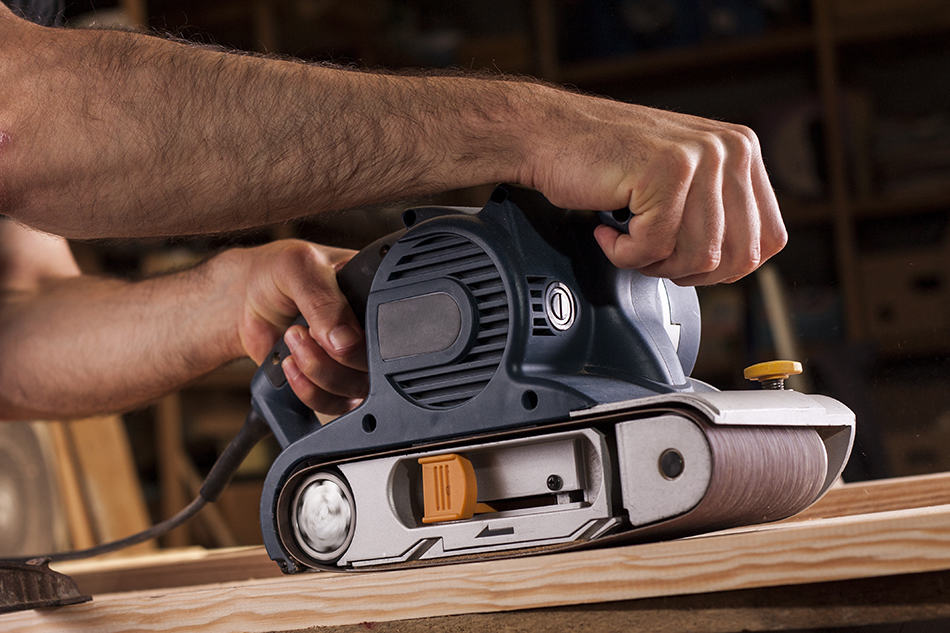
- Flattening glued-up panels. Knocking down ridges where boards meet a hair proud of each other - a random orbital would take all afternoon.
- Leveling and scribing. Sneaking a door edge or countertop down to a scribe line, a few passes at a time.
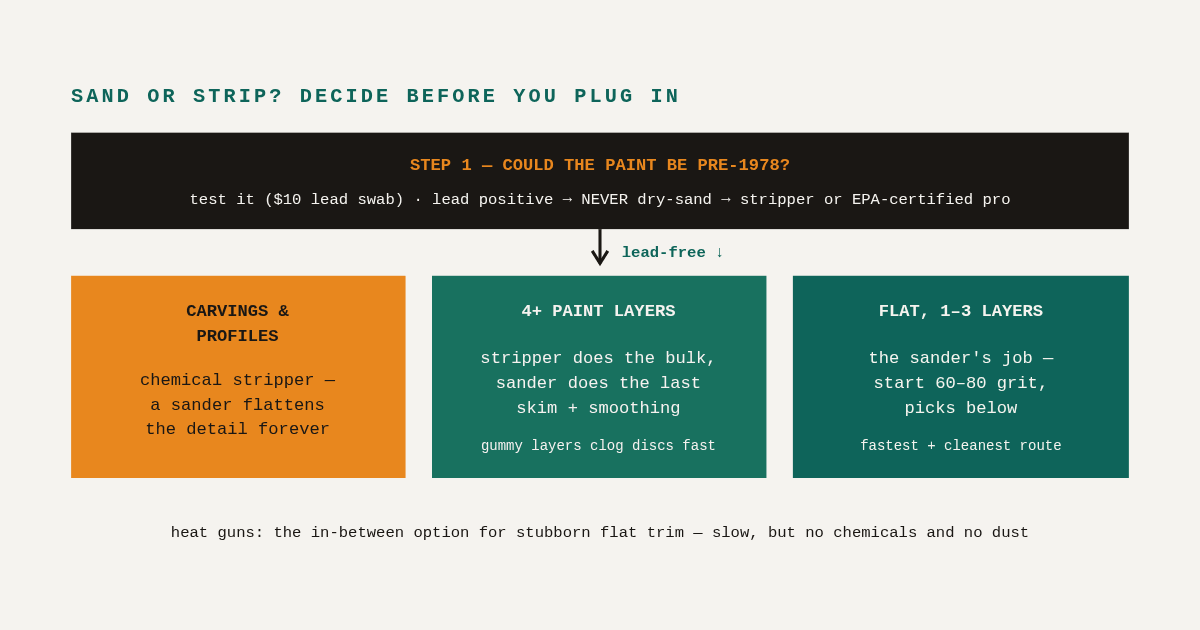
- Stripping thick paint or varnish from large flat surfaces. A 40- or 60-grit belt gets under old finish instead of melting it into the abrasive. (For siding and decks, see the dedicated guide to sanders for exterior paint removal.)
- Clamped upside down as an improvised stationary sander for shaping small parts - lock the trigger, bring the work to the belt.
The discipline it demands: keep it moving, keep it flat, sand with the grain, and never set it down while the belt is spinning. Pressing harder doesn't cut faster - it burns wood and rounds edges.
When the orbital sander wins
Everything between "roughly flat" and "ready to finish":
- Smoothing furniture before paint or oil - the core tool in any furniture sanding kit
- Removing milling marks from dimensioned lumber
- Scuff-sanding between coats of finish (with a worn 220 disc, light touch)
- Any work on veneered plywood, where a belt sander would blow through the face veneer almost instantly
Its limits are the mirror image of its strengths: pressing down on a random orbital just stalls the orbit and slows the cut. If you catch yourself leaning on it to remove material, that's the tool telling you the job belongs to a belt sander.
The workflow that uses both
On a typical refinishing or glue-up job the two tools hand off to each other:
- Belt sander, 80-grit belt - flatten, level, or strip until the surface is uniform.
- Random orbital, 100-120 - erase every straight belt scratch. Don't skip more than one grit level.
- Random orbital, 150-180 (to 220 for film finishes) - final surface. Vacuum or tack between grits.
Raking light across the surface between steps shows leftover scratches better than your fingertips will.
Which one should you buy first?
Buy the random orbital first. It does 90% of what a hobbyist sands, it's cheap to run, and it's nearly impossible to ruin a workpiece with one. Add a belt sander when your projects grow into panel glue-ups, slab work, or restoration stripping - at that point nothing else substitutes. If you're at the buying stage, start with the sanders hub for the current picks in every category.
FAQ
Can an orbital sander do what a belt sander does if I'm patient? On small areas, yes - with 60-grit discs and a lot of time. On a tabletop or a deck, no. The linear cutting action of a belt removes material several times faster, and coarse discs on an orbital clog long before the job is done.
Why does my orbital sander leave swirl marks? Usually one of four things: pressing down (stalls the random action), tilting the pad, skipping grits, or dust caking the disc. Let the sander's weight do the work, keep the pad flat, and connect a vacuum if the sander has a port.
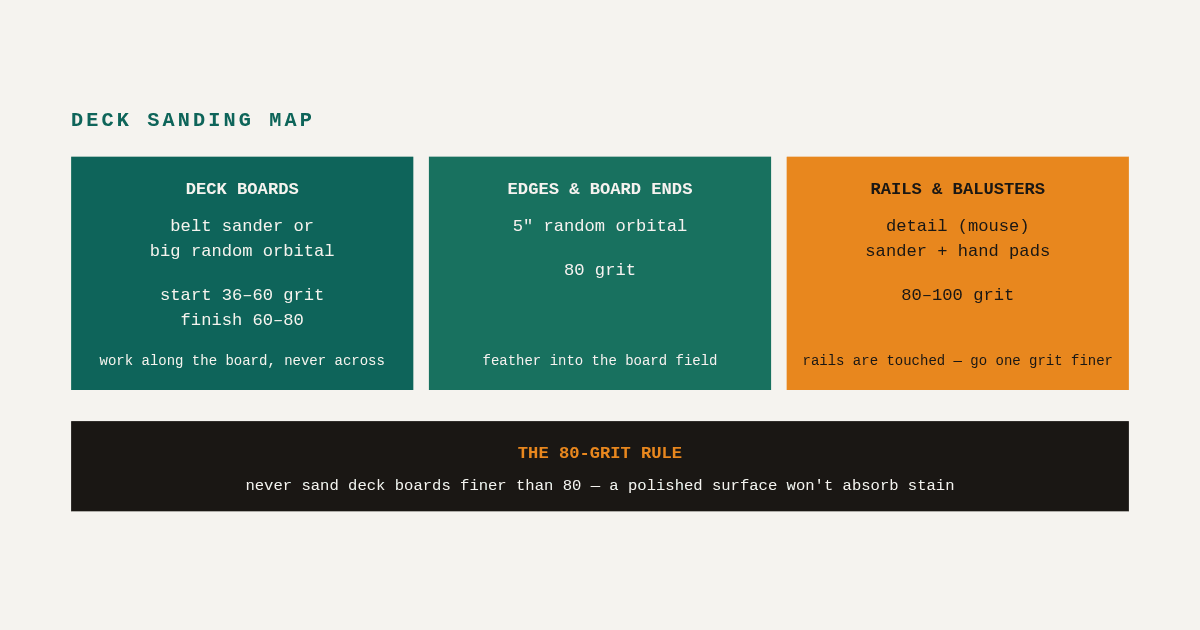
Belt sander vs orbital sander for a deck? Neither is ideal alone. A belt sander flattens boards but is punishing to use on your knees across 200 square feet; an orbital is comfortable but slow on weathered wood. Most deck refinishers use a chemical stripper first and a sander only for spot work - see the deck paint remover guide.
Is a palm sander the same as an orbital sander? "Palm sander" describes the grip, not the mechanism - most are quarter-sheet orbital (square pad, mild swirls) or small random orbitals. The pointed-pad variant for corners is the mouse sander, which has its own roundup.
Do belt sanders work on metal? Yes - with the right abrasive (zirconia or ceramic belts, not standard aluminum oxide), a belt sander deburrs steel and can regrind rough edges on shovels and axes. Keep a dedicated belt for metal; embedded steel particles will stain the next piece of oak you sand.
Verdict
A belt sander and an orbital sander answer two different questions. "How do I make this flat?" - belt sander. "How do I make this smooth?" - random orbital. If you're equipping a shop from zero: random orbital now, belt sander when your projects demand it, and the quarter-sheet and detail sanders only for the niches they serve.