Best Floor Paint: 6 Picks for Wood, Concrete & Garage Floors
Affiliate disclosure: As an Amazon Associate, WoodyMan Reviews earns from qualifying purchases. If you buy through links on this page, we may earn a commission at no extra cost to you. How this works.
The single most important thing about floor paint is matching it to your surface, because "floor paint" spans products that behave nothing alike. Porch and deck boards want a flexible acrylic floor enamel that moves with the wood and grips foot traffic. A garage slab wants a hard 2-part epoxy that shrugs off hot tires, oil, and road salt. A basement or utility floor is fine with a cheaper 1-part epoxy paint. Stairs and ramps need a grit-loaded anti-slip coating. Use a garage epoxy on flexing porch boards and it cracks; use a porch enamel on a garage slab and hot tires peel it. Get the surface right first, and the pick almost makes itself.
The six below are organized by that decision. If your floor is specifically interior wood (living areas, not a porch), our dedicated best paint for wooden floors guide goes deeper on those enamels; this page is the broader map across wood, concrete, and traffic surfaces.
We earn a small commission from the Amazon links below, at no extra cost to you - see our affiliate disclosure.
The 6 best floor paints
| Floor Paint | Best for | Woody Rating | |
|---|---|---|---|
| 1. KILZ Porch & Patio Enamel | Best overall - wood & concrete porches | 9.3/10 [Editor's Choice] | Check price |
| 2. INSL-X Tough Shield | Most durable acrylic floor enamel | 9.0/10 | Check price |
| 3. Rust-Oleum EpoxyShield (2-part) | Best for garage floors | 8.9/10 | Check price |
| 4. KILZ 1-Part Epoxy | Best value for basements & utility slabs | 8.6/10 | Check price |
| 5. INSL-X Sure Step | Best anti-slip for stairs & ramps | 8.5/10 | Check price |
| 6. Rust-Oleum RockSolid 6X Deck | Resurfacing weathered porch boards | 8.2/10 | Check price |
1. KILZ Porch & Patio Enamel - Editor's Choice
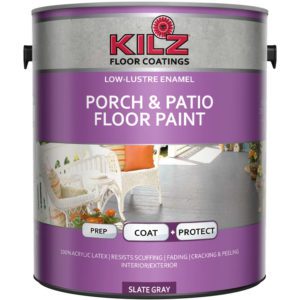
Best for: the most common job - a wood or concrete porch, deck, or patio floor that needs a tough, walkable finish.
This is the floor paint most people should reach for first. It's a latex-acrylic enamel formulated specifically for foot traffic, and it does the one thing generic paint can't: it stays flexible enough to move with wood as it expands and contracts, so it resists the cracking and peeling that kills wall paint used on floors. It goes down easily by brush or roller, self-levels to a low-sheen finish that hides imperfections, and holds up to weather, scuffs, and mild chemicals on both wood and concrete. It won't take hot tires like a garage epoxy will - that's not its job - but for porches, patios, steps, and covered decks, it's the reliable, no-drama choice.
| Pros | Cons |
|---|---|
| ✅ Flexes with wood - resists cracking/peeling | ❌ Not for garage floors / hot-tire areas |
| ✅ Works on wood and concrete | ❌ Low-sheen, not a high-gloss finish |
| ✅ Easy brush/roller application, self-levels | |
| ✅ Weather- and scuff-resistant |
2. INSL-X Tough Shield - Most Durable Enamel
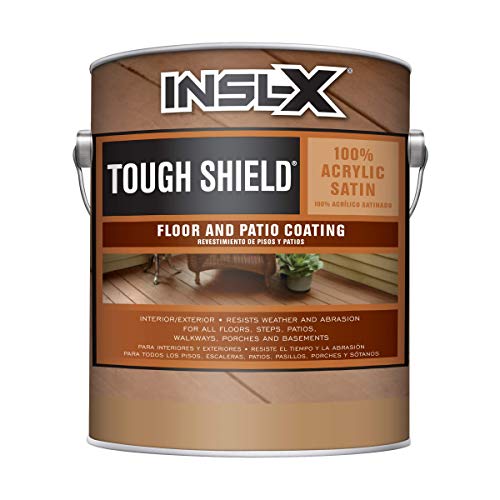
Best for: high-traffic porches, pool decks, and floors where you want the toughest acrylic enamel and one-coat coverage.
Tough Shield is the premium version of the porch-enamel category - a waterborne acrylic that lays down a genuinely rugged satin finish and resists oil, detergents, scratches, and weather better than most floor paints in its class. Its standout is coverage: it's opaque and even enough that many floors need only a single coat, and it works across masonry, concrete, and wood, indoors or out, including pool decks. It costs more than a basic porch enamel, and like all acrylic enamels it isn't a garage-floor coating - but for a high-use porch or deck you want to paint once and forget, the durability premium is money well spent.
| Pros | Cons |
|---|---|
| ✅ Toughest acrylic enamel here; satin finish | ❌ Pricier than basic porch paint |
| ✅ Often one-coat coverage | ❌ Still not a hot-tire garage coating |
| ✅ Resists oil, detergents, scratches, weather | |
| ✅ Wood, concrete, masonry, pool decks |
3. Rust-Oleum EpoxyShield - Best for Garage Floors
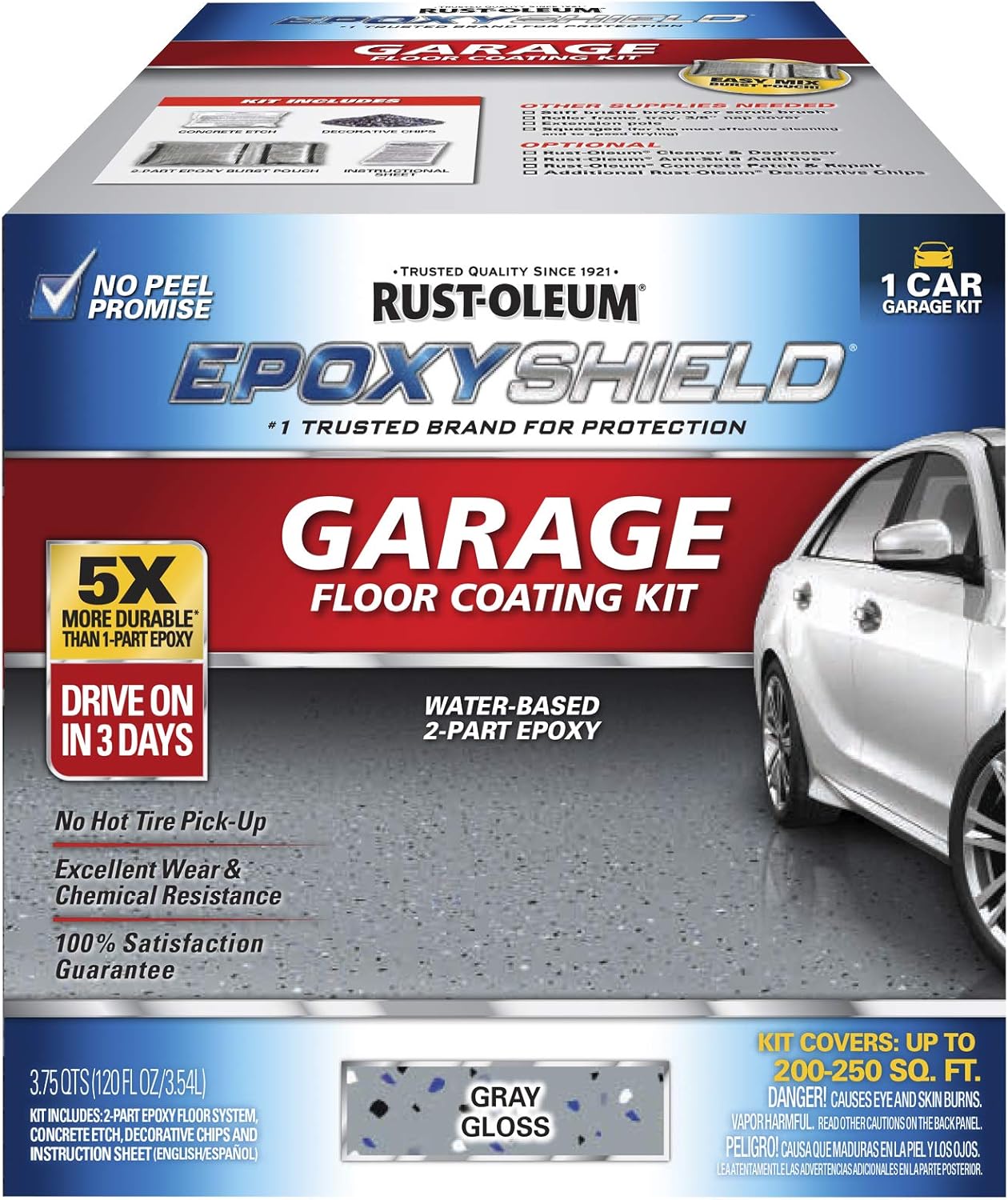
Best for: garage slabs that see cars, oil, and salt - the one floor where you genuinely need 2-part epoxy.
A garage floor is the case where porch enamel fails and you must step up to a 2-part epoxy, and EpoxyShield is the proven kit. You mix the resin and hardener, and it cures into a hard, glossy, chemically-bonded film that resists the things that lift ordinary paint off concrete: hot-tire pickup, gasoline, motor oil, antifreeze, and road salt. The kit includes the coating, a concentrated cleaner/etch, decorative flakes, and instructions, and it transforms a dusty gray slab into a showroom finish. The catch is prep and process - the concrete must be clean, etched, and fully dry, you work in a defined pot-life window before the mixed epoxy sets, and humidity/temperature during cure matter. Do the prep right and it lasts for years; skip it and even the best epoxy peels.
| Pros | Cons |
|---|---|
| ✅ Resists hot tires, oil, gas, salt | ❌ Demands thorough etch + prep or it peels |
| ✅ Hard, glossy, chemically-bonded film | ❌ Limited pot life once mixed |
| ✅ Complete kit with cleaner and flakes | ❌ Cure sensitive to temp/humidity |
| ✅ Years of durability on a slab |
4. KILZ 1-Part Epoxy - Best Value for Basements
Best for: basements, utility rooms, and light-duty slabs where full 2-part epoxy is overkill.
Not every concrete floor needs the full 2-part treatment, and the KILZ 1-part epoxy-acrylic is the sensible middle ground. It's a single-component paint - no mixing, no pot-life clock - that rolls on like regular paint and cures to a satin finish tougher than latex, resisting scuffing, cracking, peeling, and fading on concrete. For a basement floor, a laundry room, a workshop that doesn't park cars, or a covered patio, it delivers most of the practical benefit at a fraction of the cost and hassle of true epoxy. Be clear on the ceiling: it's more durable than porch paint but less chemical- and hot-tire-resistant than 2-part epoxy, so it's not the pick for a working garage. For everything short of that, it's the value winner.
| Pros | Cons |
|---|---|
| ✅ No mixing - rolls on like paint | ❌ Less hot-tire/chemical resistance than 2-part |
| ✅ Tougher than latex; satin finish | ❌ Not for a working garage slab |
| ✅ Great value for basements/utility floors | |
| ✅ Interior/exterior concrete |
5. INSL-X Sure Step - Best Anti-Slip
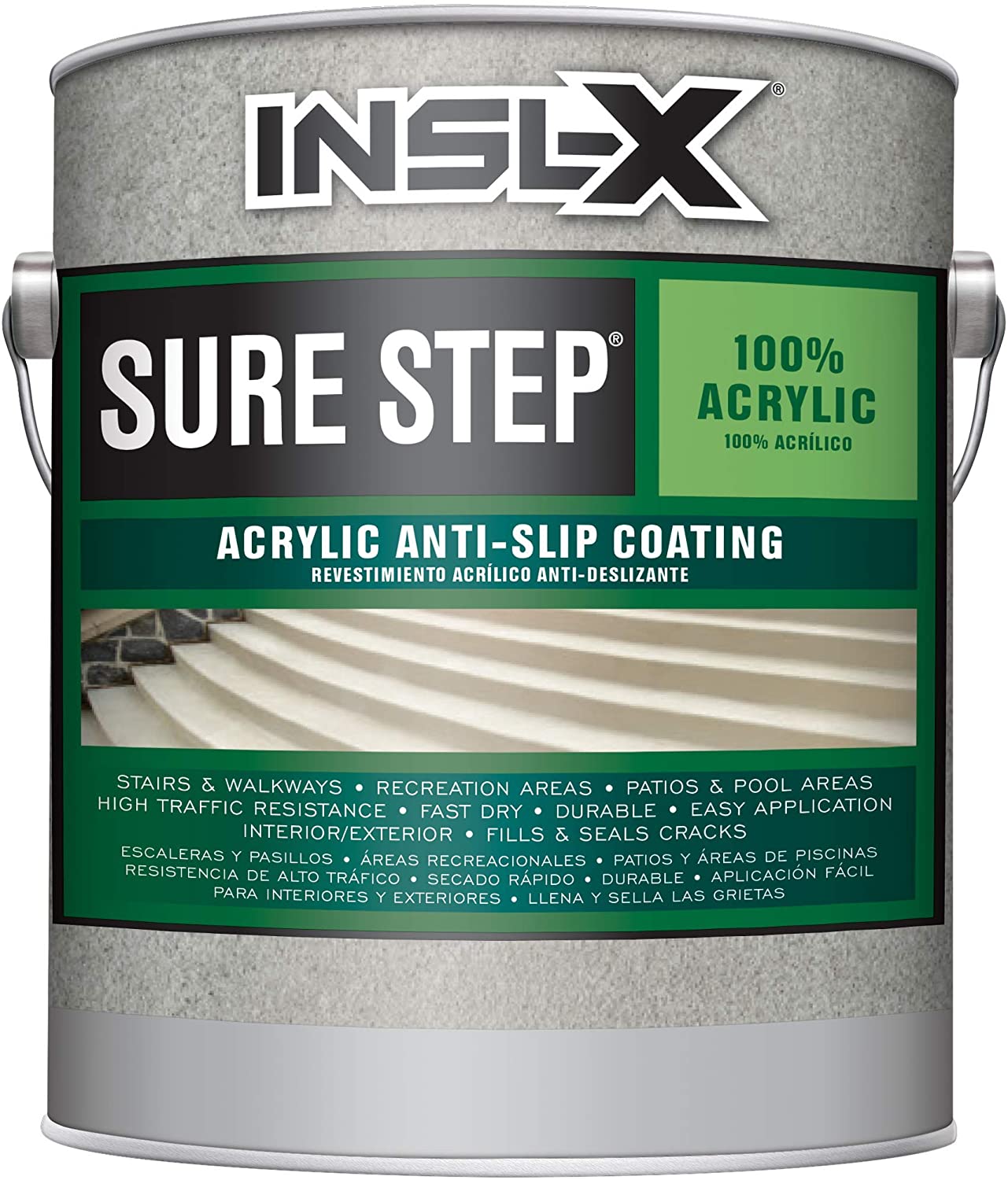
Best for: stairs, ramps, walkways, and pool surrounds where traction is a safety issue, not a nice-to-have.
Freshly painted floors get slick, and on steps or a ramp that's genuinely dangerous - which is exactly the problem Sure Step is built to solve. It's an acrylic coating with a fine aggregate blended in, so it cures to a low-profile textured surface that grips underfoot even wet, while still cleaning up easily and holding its color. Use it on exterior stairs, ramps, walkways, decks, and pool decks where slip resistance matters most. Two practical notes from the field: prime bare or glossy surfaces first for best adhesion despite the "self-priming" billing, and coverage per gallon is lower than smooth paints because of the texture - buy accordingly. Where safety underfoot is the priority, nothing else here competes.
| Pros | Cons |
|---|---|
| ✅ Real anti-slip texture, even when wet | ❌ Lower coverage per gallon (it's gritty) |
| ✅ Great color retention, easy cleanup | ❌ Prime bare/glossy surfaces first |
| ✅ Stairs, ramps, walkways, pool decks | |
| ✅ Durable acrylic that holds up outdoors |
6. Rust-Oleum RockSolid 6X Deck - For Weathered Boards
Best for: old, splintered, cracked porch or deck boards too far gone for ordinary paint to save.
When boards are past the point where a thin coat of enamel will help - cracked, splintering, gray, checked - you need a resurfacer, not a paint, and RockSolid 6X is that. It goes on far thicker than standard floor paint, filling cracks and splinters and laying down a durable, slip-resistant, textured coat that makes a weathered deck walkable and uniform again. It's the "one more season (or several)" rescue for a porch you're not ready to replace. In exchange for that thickness it's fussier to apply - heavier rolling, more product, careful attention to an even coat - and the surface is deliberately textured rather than smooth. On sound wood a normal enamel is the better and cheaper choice; on genuinely rough boards, this is what brings them back.
| Pros | Cons |
|---|---|
| ✅ Fills cracks and splinters - resurfaces | ❌ Overkill (and pricier) on sound wood |
| ✅ Thick, durable, slip-resistant coat | ❌ Heavier, fussier application |
| ✅ Revives weathered decks and porches | ❌ Textured, not smooth |
Buying guide: match the paint to the floor
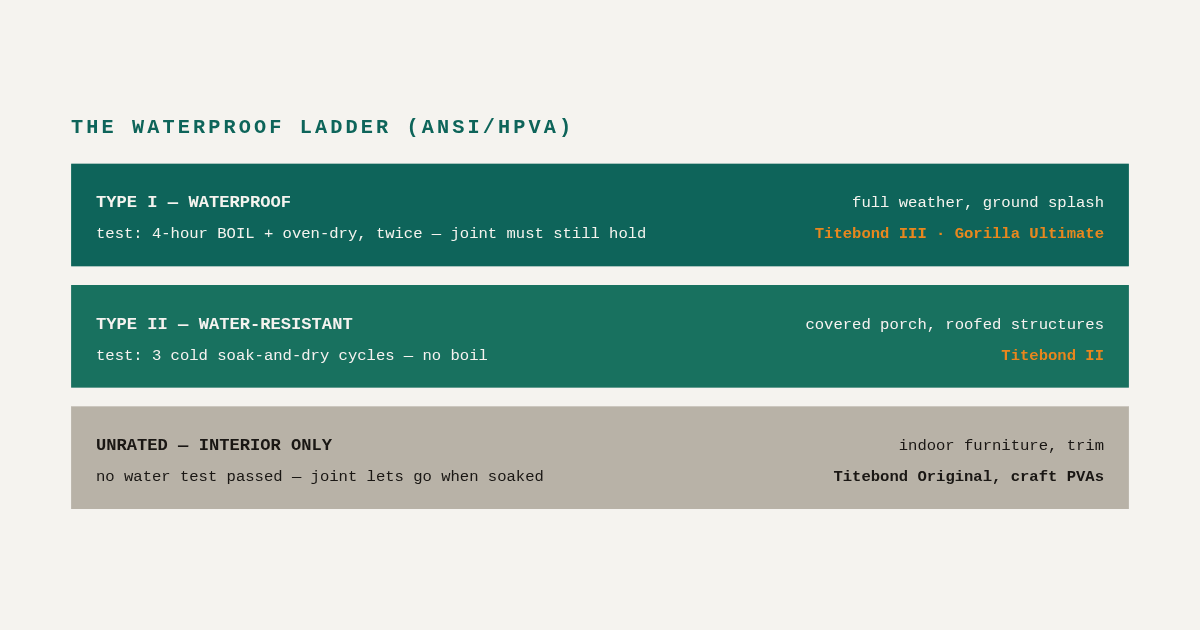
Surface decides everything. Wood porch/deck → acrylic floor enamel (picks 1, 2). Garage slab with vehicles → 2-part epoxy (pick 3). Basement or utility concrete → 1-part epoxy (pick 4). Stairs/ramps → anti-slip coating (pick 5). Weathered, cracked boards → resurfacer (pick 6). Crossing those wires - epoxy on flexing wood, enamel on a hot-tire slab - is the number-one cause of peeling floor paint.
Prep is 80% of the outcome. Every failure story traces to prep. Concrete must be clean, degreased, etched (for epoxy), and bone dry - test for moisture with the plastic-sheet-taped-down trick before coating a slab. Wood must be clean, dry, and sanded dull; strip failing old coatings first - our paint remover for wood decks guide covers that. Skip prep and even the best product lifts.
Coverage and coats. Most of these run 300-450 sq ft per gallon on smooth surfaces; textured products (Sure Step, RockSolid) cover less. Measure your floor, and if a product needs two coats, halve the coverage in your math so you don't run short mid-job. Our wood CFT calculator helps if you're also estimating materials for a related build.
Traction and temperature. Any smooth floor paint gets slippery wet; add an anti-slip additive or use Sure Step on steps and wet areas. And respect the temperature window on the can - most cure poorly below ~50°F or in high humidity, which is why fall garage-epoxy jobs so often go wrong.
Related finishes. Painting isn't always the answer: for exterior wood you may want stain instead - see best oil-based deck stain - and for house siding rather than floors, best exterior paint for wood siding and our wood paint pillar cover the broader picture.
Frequently Asked Questions
What's the difference between floor paint and epoxy?
Floor paint (acrylic enamel) is a flexible single coat that flexes with wood and grips foot traffic - ideal for porches and decks. Epoxy is a harder, chemically-bonded coating (often 2-part) that resists hot tires, oil, and chemicals on concrete - ideal for garages. Use each on the surface it's built for.
Can I paint a garage floor with regular porch paint?
Not successfully. Vehicle tires get hot and lift ordinary floor and porch paint off concrete ("hot-tire pickup"). A garage slab with cars needs 2-part epoxy (pick 3); porch enamel is for foot-traffic surfaces.
Do I need to prime before painting a floor?
Usually yes on bare, glossy, or previously coated surfaces, and always etch bare concrete before epoxy. Some products self-prime on sound, clean surfaces, but priming is cheap insurance against peeling - especially under anti-slip coatings.
How long before I can walk on or park on a painted floor?
Typically foot traffic after 24 hours and full cure in about 5-7 days, but it varies by product, temperature, and humidity - check the can. For garage epoxy, wait the full cure before parking a car on it, or the tires can mar a green coating.
How do I keep a painted floor from being slippery?
Use an anti-slip coating like Sure Step on stairs and wet areas, or mix a fine anti-slip additive into a smooth floor paint's final coat. Textured resurfacers like RockSolid are inherently grippier than smooth enamels.