How to Oil a Wooden Cutting Board (and Which Oil to Use)
Affiliate disclosure: As an Amazon Associate, WoodyMan Reviews earns from qualifying purchases. If you buy through links on this page, we may earn a commission at no extra cost to you. How this works.
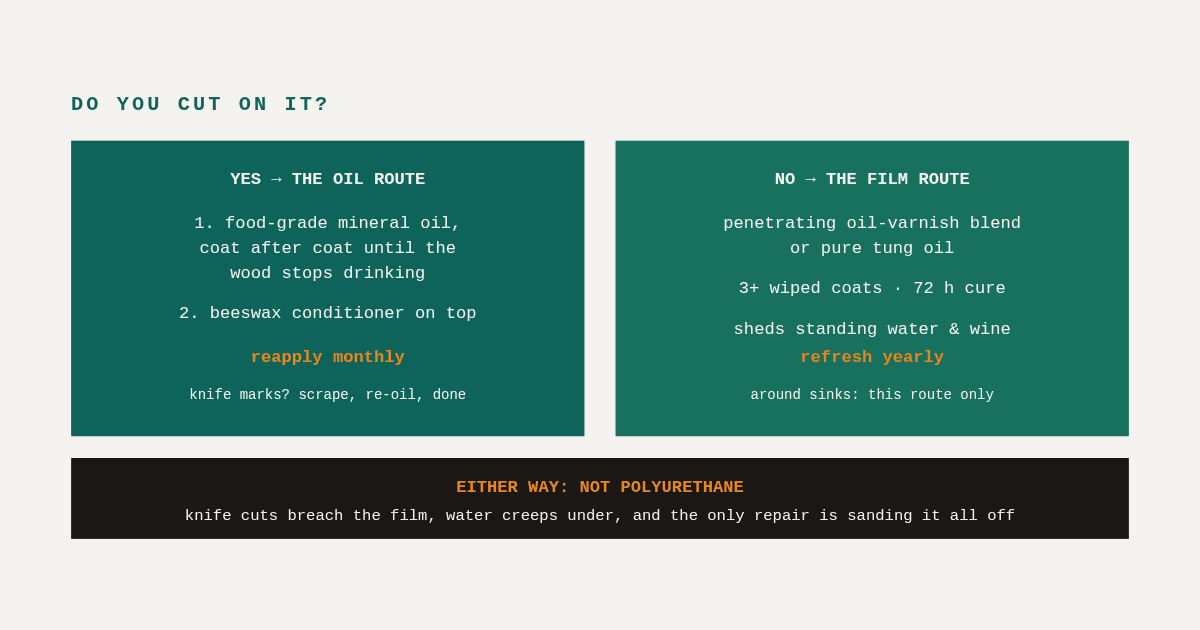
Short answer: wash and fully dry the board, flood every face (edges and ends too) with food-grade mineral oil, let it soak at least 20 minutes - overnight for a new or thirsty board - then wipe off what's left and stand it on edge to dry. Seal with a beeswax board cream if you want water to bead. Re-oil whenever a drop of water soaks in instead of sitting on top, which for most kitchens means about once a month.
A wooden board doesn't need much, but it needs the right thing. Oil keeps the fibers full so water and juices can't soak in, which is what stops warping, cracking and that grey, fuzzy look a neglected board gets. The wrong oil (anything from the pantry) goes rancid inside the wood, and you can't get the smell back out. This guide covers the routine, how often, and the four products worth buying. If you're finishing a whole butcher block counter rather than a board, see our best finish for butcher block guide, which covers the counter-only film finishes too.
We earn a small commission from the Amazon links below, at no extra cost to you - see our affiliate disclosure.
Step by step
1. Start clean and completely dry. Wash with hot, soapy water, rinse, towel it off, then let it air-dry standing on edge for a few hours. Oil won't go into wood that's already full of water. Never put a wooden board in the dishwasher or leave it soaking in the sink - that's how boards split and glue lines fail.
2. Knock down raised grain (new boards only). The first few washes lift the wood fibers and the surface goes slightly fuzzy. A quick pass with 220-grit sandpaper, with the grain, fixes it. Wipe off the dust before oiling. (Not sure which grit? Our sandpaper grit chart has the full ladder.)
3. Flood every face. Pour a generous amount of food-grade mineral oil on the board and spread it with a clean cloth or paper towel - both faces, all four edges. The end grain (the ends where you can see the growth rings) soaks up the most, so give it extra. On an end-grain board the whole top behaves like that, and it will take noticeably more oil than an edge-grain board.
4. Let it soak. Twenty minutes is the minimum. For a brand-new board, or one that looks pale and dry, leave it overnight. New boards usually need a coat a day for the first week before they stop drinking it all in.
5. Wipe off the excess and stand it up. Whatever is still sitting on the surface won't go in; wipe it away so the board isn't sticky. Stand it on edge (or on a rack) so air reaches both faces while it settles.
6. Seal with board cream (recommended). A cream or conditioner made of mineral oil plus beeswax leaves a thin wax layer on top of the oiled wood. Rub a little in, let it sit a few minutes, and buff it off. Water beads on a waxed board in a way it never does on plain oil, and the board stays cleaner between oilings.
How often to oil a cutting board
Go by the board, not the calendar. Do the water test: put a few drops on the surface. If they bead, the board is fine. If they soak in and the wood goes dark, it's time. For a board used daily and washed often, that works out to roughly monthly; a board that mostly sits on the counter can go longer. Other signs it's overdue: a pale, chalky or grey look, a rough feel, or the board holding onto smells.
Which oil is safe for a cutting board
| Oil | Use it? | Why |
|---|---|---|
| Food-grade (USP) mineral oil | Yes - the standard | Colorless, odorless, and it never goes rancid |
| Board cream / conditioner (mineral oil + beeswax) | Yes - the top coat | Adds a wax layer so water beads |
| Fractionated coconut oil | Yes | Stays liquid and resists going rancid, unlike regular coconut oil |
| Walnut oil | With care | Food safe and it hardens slowly, but think about nut allergies before you use it on a shared board |
| Olive, vegetable, sunflower, canola | No | They oxidize and go rancid inside the wood - the smell doesn't wash out |
| Boiled linseed oil, furniture oils, polyurethane | No | Boiled linseed contains metallic drying agents, and a film finish gets cut to pieces and traps water underneath |
What about tung oil? Pure tung oil is food safe once fully cured, but that takes 2-4 weeks and several thin coats, so mineral oil is far less hassle for a board. Danish oil and products labeled "tung oil finish" contain varnish and driers and belong on furniture, not cutting surfaces - see danish oil vs tung oil.
DIY board butter
If you'd rather mix your own top coat, it's two ingredients: about 1 part beeswax to 4 parts food-grade mineral oil, by weight. Melt the beeswax gently in a jar set in a pan of hot water (not over direct heat), stir in the oil, and pour it into a tin. It sets into a soft paste you rub on with a cloth after oiling. More beeswax makes it firmer and more water-resistant; more oil makes it easier to spread.
The four products worth buying
Food-grade mineral oil is the only thing a board truly needs - everything else is convenience. These are the four we'd point you to, and the reason each is on the list:
- Thirteen Chefs Mineral Oil - the base coat. USP food grade, 12 oz with a spout that makes flooding a board easy. The cheapest way to do the soaking steps.
- Howard Butcher Block Conditioner - oil and wax in one bottle (mineral oil with beeswax and carnauba). If you only buy one product, buy this one and use it for both steps.
- John Boos Board Cream - a thicker beeswax-and-mineral-oil cream for the sealing step, from the company that has made butcher block since 1887.
- John Boos Mystery Oil + Board Cream set - the two-step system as a pair: a thin oil that penetrates deep (good for end-grain boards) and the cream to seal it.
Keeping it clean between oilings
- After every use: hot soapy water, rinse, towel dry, stand on edge. That's it.
- After raw meat: the same wash, then wipe with white vinegar or 3% hydrogen peroxide and let it dry. Many cooks keep a separate board for raw meat.
- Smells or stains: scrub with coarse salt and half a lemon, rinse, dry, then re-oil - the scrub strips some oil along with the smell.
- Deep knife marks or fuzz: sand lightly (180 then 220), wipe off the dust, and oil it like a new board.
Frequently Asked Questions
Can you over-oil a cutting board?
Not really. The wood absorbs what it can hold and the rest stays on the surface. The only mistake is leaving that excess on, which makes the board sticky and attracts dust - so always wipe off what's left after soaking.
How long after oiling can I use the board?
Once the excess is wiped off and the surface feels dry, it's safe - mineral oil doesn't need to cure. Leaving it overnight lets more oil soak in, which is why the evening is the best time to do it.
Can I use olive oil on a cutting board?
No. Olive oil and other cooking oils go rancid inside the wood over time and leave a sour smell you can't wash out. Use food-grade mineral oil, a board cream, or fractionated coconut oil.
Does oiling sanitize a cutting board?
No - oil protects the wood, it doesn't clean it. Wash with hot soapy water first, and use vinegar or hydrogen peroxide after raw meat. A well-oiled board is easier to keep clean because liquids stay on the surface instead of soaking in.
Do bamboo cutting boards need oil?
Yes, the same oil and the same routine, though bamboo is denser and usually needs it less often. Do the water test and oil it when drops stop beading.
Related reading
Finishing a counter or island instead of a board? Start with the best finish for butcher block. For the wider world of wood finishes, see the wood paint and finish hub, and for clear finishes on furniture, polyurethane vs varnish vs lacquer.