Danish Oil vs Tung Oil: Which to Use and How to Apply Each
Affiliate disclosure: As an Amazon Associate, WoodyMan Reviews earns from qualifying purchases. If you buy through links on this page, we may earn a commission at no extra cost to you. How this works.
Short answer: use danish oil for furniture and shop projects that need reasonable protection without fuss - it's an oil/varnish blend that dries overnight and builds a satin sheen in 2-3 coats. Use pure tung oil where food contact or a dead-natural matte look matters - cutting boards, butcher block, toys - and accept that it wants 4-6 thin coats with a day or more between each. They're not two grades of the same thing: one is a blend with varnish in it, the other is a single natural oil.
The confusion is mostly the labels' fault, so start there.
What's actually in the can
- Tung oil is a real, single ingredient: pressed from tung tree nuts, it polymerizes in air and cures in the wood to a matte, water-resistant, food-safe surface. 100% natural, no driers - which is exactly why it's slow.
- Danish oil is a recipe, not an oil - typically linseed or tung oil blended with varnish resin and mineral spirits, plus metallic driers. The thinner carries it into the wood, the oil feeds the grain, and the varnish fraction is what leaves a harder, slightly built film. "Danish" describes the look (the oiled teak of mid-century Scandinavian furniture), and every brand's recipe differs.
- The label trap: most products named "Tung Oil Finish" contain little or no tung oil - they're thinned wiping varnishes trading on the name. If the ingredient list doesn't say 100% pure tung oil, treat it as a danish-oil-style blend.
Side by side
| Factor | Danish oil | Pure tung oil |
|---|---|---|
| What it is | Oil + varnish + thinner blend | Single natural oil |
| Sheen | Satin, deepens per coat | Matte, close to bare wood |
| Coats needed | 2-3 | 4-6 thin (first coats often cut 1:1 with citrus solvent) |
| Recoat time | 8-12 hours | 24 hours minimum, longer late coats |
| Full cure | ~1 week | 2-4 weeks |
| Protection | Better - varnish fraction resists spills and wear | Good water resistance, soft film |
| Food contact | Only when fully cured; not the natural choice | Yes - the classic butcher-block finish |
| Color shift | Warms; brand-dependent tint | Slight honey tone, ambers slowly |
| Repair | Both trivial - scuff and wipe another coat, no stripping | |
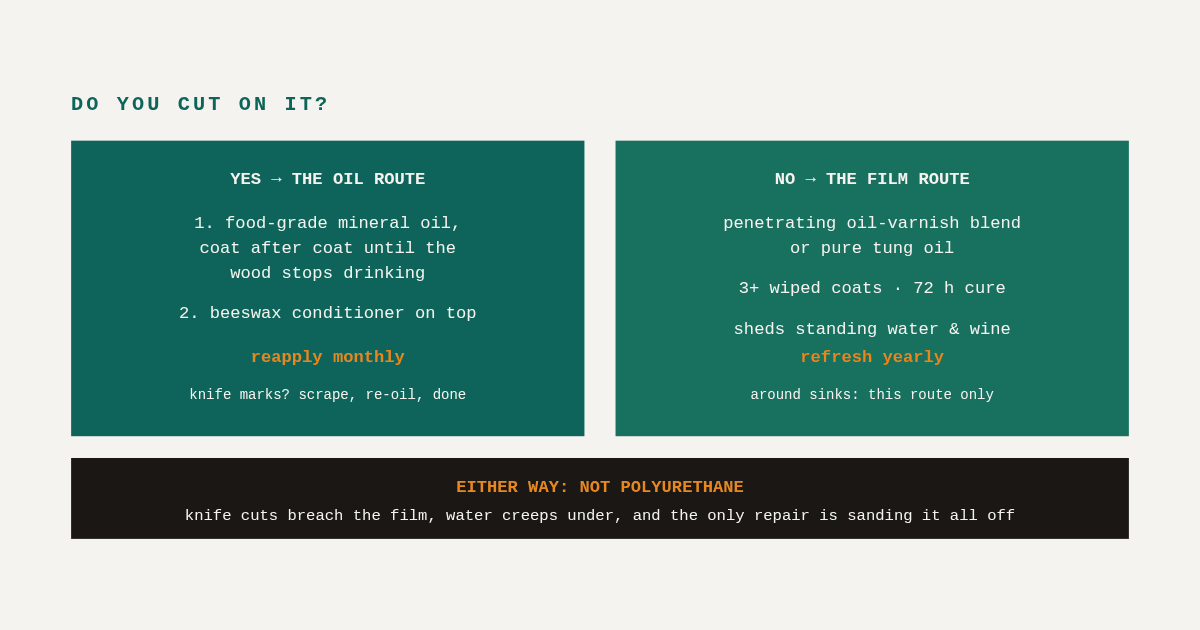
That last row is why oil finishes stay popular against film finishes like polyurethane: a worn oiled surface never peels and never needs stripping - you just feed it another coat.
Pick by project
- Bookshelf, desk, mid-century furniture revival: danish oil - the satin build and overnight recoats make it the least frustrating real-wood finish for furniture. Watco's Danish Oil in Natural is the classic can.
- Cutting board, butcher block, salad bowl, kids' toys: pure tung oil - Hope's 100% Pure Tung Oil is the reliably pure one - or plain mineral oil for zero effort. Cured tung is inert; danish oil's driers and resins make it the wrong instinct here even though cured films are generally considered safe.
- Anything that lives outside or takes standing water: neither - these are low-protection finishes. Exterior wood wants real outdoor coatings.
- Turned bowls and small work: either; tung if it'll touch food. Both wet-sand beautifully - applying the final coat with fine abrasive is the classic trick, covered in wet sanding wood.
- Workbench, hand-tool handles: danish oil. Fast, renewable, and grippy rather than slick.
How to apply tung oil
Pure tung oil rewards patience. The steps:
- Sand to 180-220 grit and remove all the dust. Oil finishes show sanding scratches, so don't skip grits.
- Thin the first coat or two. Mix the tung oil about 1:1 with citrus solvent or mineral spirits so it soaks deep into the wood. (Some pure tung oils, like Hope's, can go on straight; check the label.)
- Flood it on with a rag or brush and keep the surface wet for 20-30 minutes, adding oil to any spots that soak it up and go dry.
- Wipe off everything left on the surface. This is the step that matters most. Tung oil left sitting on top cures into a sticky, gummy skin.
- Wait at least 24 hours before the next coat, and longer in cool or humid weather. If the surface still feels tacky, it isn't ready.
- Lightly buff between later coats with #0000 steel wool or 400-grit paper, wipe off the dust, and apply the next coat, thinning less (or not at all) as you go.
- Stop at 4-6 coats, when the surface has an even, soft sheen. Let it cure for 2-4 weeks before heavy use or food contact.
How to apply danish oil
Danish oil is much quicker. Flood a generous coat onto bare wood sanded to 180-220, keep it wet for 15-30 minutes, then wipe off all the excess. Let it dry overnight (8-12 hours), apply a second coat the same way, and a third if you want more sheen. For an extra-smooth feel, wet-sand the second coat into the wood with 400-600 grit paper before wiping it off.
With either product, lay used rags flat to dry or drown them in water. Oxidizing oil rags heat up as they dry and genuinely do start fires.
FAQ
Is danish oil waterproof? Water-resistant: a coaster-grade finish, not a bar-top one. Standing water left overnight will print a mark. Three cured coats shrug off splashes and glass rings wiped up the same evening; for real water exposure you want a film finish.
Can you eat off tung oil? Fully cured pure tung oil is widely regarded as food-safe and is the traditional butcher-block choice. The caveats: it must be pure tung (not "Tung Oil Finish"), and it must be genuinely cured - give it the full 2-4 weeks before food contact. Rare nut-allergy concerns are mostly theoretical once cured, but worth knowing.
Can you put polyurethane over danish oil? Yes, once the danish oil has cured fully - a week or more, not overnight. Oil-based poly over cured danish oil is a common combo (color from the oil, armor from the poly). Waterborne poly over any oil is riskier; test adhesion first.
Is tung oil good for wood? Yes, for the right job. It gives a natural matte look, resists water better than most oils, never peels, and is food safe once cured. The downsides are time (weeks for a full finish) and modest protection against scratches and heat compared with varnish or polyurethane. It's best on furniture you want to look and feel like bare wood, turned bowls, cutting surfaces and tool handles.
How many coats of tung oil do you need? Four to six thin coats for real protection, cutting the first coat or two 1:1 with a solvent so it penetrates. Each coat needs at least 24 hours, and later coats dry slower. It's a project you finish over two weeks - the price of a 100%-natural finish.