Wood Lathe Speed Chart: Safe RPM by Blank Diameter
The rule: blank diameter (inches) × RPM should land between 6,000 and 9,000. Divide 6,000 by the diameter for your minimum working speed, 9,000 for your maximum - so a 10" bowl blank runs 600-900 RPM, a 2" pen blank runs as fast as the machine goes. Start every new blank at the bottom of its band or below, and ignore the math entirely (go slower) whenever the blank is out of round, cracked, or making the lathe walk. The full chart is below - bookmark it; the question never stops coming up.
The full chart
| Blank diameter | Min (6,000 ÷ D) | Max (9,000 ÷ D) | Typical work |
|---|---|---|---|
| 1" | machine max | machine max | pens, finials |
| 2" | 3,000 | 4,000+ (machine-capped) | pens, small spindles |
| 3" | 2,000 | 3,000 | handles, boxes |
| 4" | 1,500 | 2,250 | small bowls, peppermills |
| 5" | 1,200 | 1,800 | bowls, vases |
| 6" | 1,000 | 1,500 | bowls |
| 8" | 750 | 1,125 | salad bowls |
| 10" | 600 | 900 | large bowls |
| 12" | 500 | 750 | large bowls, small platters |
| 14" | ~430 | ~645 | platters |
| 16" | ~375 | ~560 | large platters |
For diameters between the rows - or for a starting speed adjusted to your blank's actual condition - the lathe speed calculator runs the same rule interactively, safety overrides included.
Why the band collapses so fast: the wood doesn't feel RPM, it feels rim speed, and rim speed grows with diameter. A 16" platter at 560 RPM has its rim moving about as fast as a 2" pen blank at 4,500. Meanwhile the energy stored in a spinning blank grows with the square of both size and speed - which is why the big-blank end of the chart is where the safety margin matters most.
When to ignore the chart (always downward)
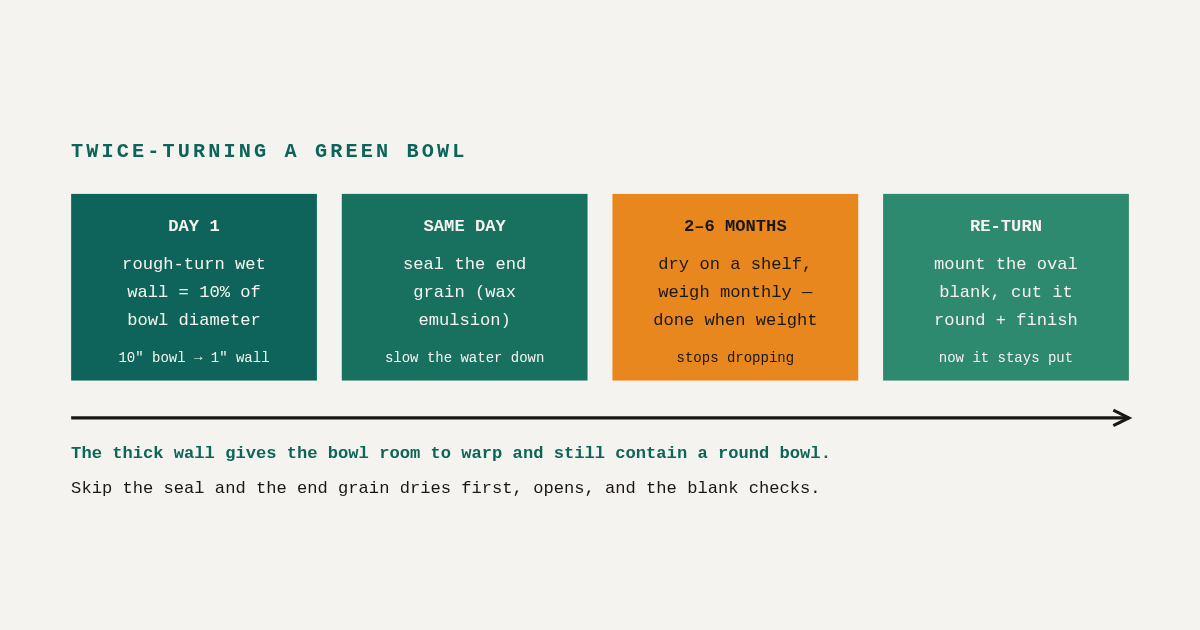
- Any new blank starts slow. The 6,000 minimum assumes a round, balanced, sound blank. A fresh chainsaw-cut bowl blank is none of those - start at your machine's lowest speed, stand out of the firing line, and speed up in steps as it cuts round. This goes double for wet wood, which is heavier and rarely balanced; see turning green wood.
- Vibration is a veto. If the lathe shakes or walks, the speed is wrong for that blank right now, whatever the math says. Slow down until it smooths out. (A machine that shakes at every speed with a balanced blank has a mass problem, not a speed problem - cheap lathes live and die by cast iron, as our budget lathe guide belabors.)
- Cracks, bark inclusions, punky wood: treat the chart's minimum as your maximum, and keep the tailstock up whenever the work allows.
- Faster is never the fix for a bad cut. Torn grain wants a sharper edge and better tool presentation, not more RPM. Speed hides problems until it can't.
Speeds for the other jobs
- Roughing (square → round, unbalanced): lowest available, then step up. This is where a low floor earns its money - it's why we flag minimum speed in every lathe review.
- Finishing cuts on a balanced piece: top of the band. Higher rim speed with a light cut leaves a cleaner surface.
- Sanding on the lathe: slow - a few hundred RPM. High speed just heats the abrasive, glazes the surface, and burns fingers.
- Applying friction polish: the exception - moderate-to-high speed generates the friction that cures it.
- Drilling on the lathe: ~500 RPM for larger bits; clear chips often.
Does your lathe actually reach these speeds?
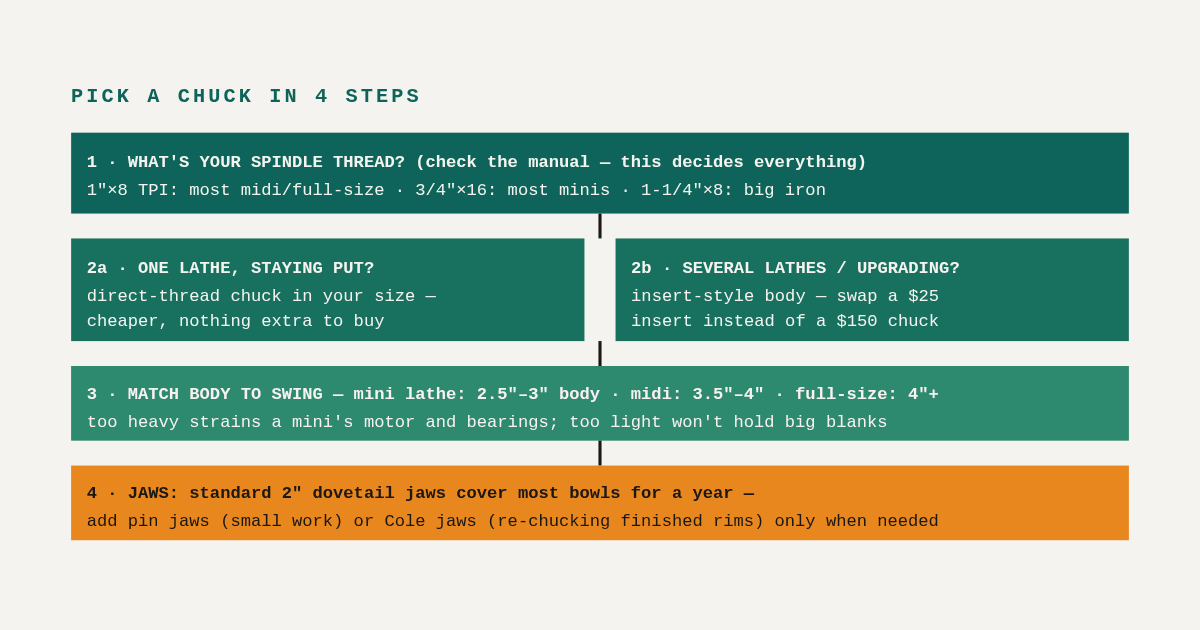
Two spec-sheet numbers decide whether the chart is usable on your machine: the speed floor (bowl roughing wants ≤ 600, ideally ≤ 500) and how speeds change - belt-swap lathes give you 5 fixed speeds; electronic variable speed gives you exactly what the blank wants, instantly. It's the biggest practical difference between the budget machines and the step-up midis, and for bowl-heavy turning it's worth ranking above horsepower - the low-speed behavior of each machine is half of what our bowl lathe guide grades. New to all of it? The lathe hub and the bowl turning walkthrough set the full context, and make sure the blank is actually held right before chasing speed - a proper chuck grip matters more than any RPM.
FAQ
What speed should I turn a 10-inch bowl blank? 600-900 RPM once it's running true - but start a rough blank at your machine's minimum and work up. Final cuts near 900 with a sharp gouge; sanding back down to a few hundred.
What speed for pen turning? Effectively as fast as your lathe goes - a 3/4" blank's math says 8,000+ RPM, so the real limit is the machine's top speed (usually 3,600-4,000). High speed plus light cuts is the pen formula.
Why does my lathe shake at high speed? The blank is out of balance (oval, off-center, uneven density), the speed is too high for its diameter, or the lathe is too light for the job. Slow down first; if a balanced round blank still shakes everywhere, bolt the lathe down or add mass.
Is there one safe speed for everything? No - safe speed is a function of diameter. But if a lathe could hold only one speed for general small work, ~1,200 RPM covers 3-5" blanks tolerably. Anything bowl-sized needs slower; anything pen-sized wants faster.
Do these speeds apply to resin and segmented blanks? The math does, but run resin cooler (heat melts it - stay mid-band and take light cuts) and treat unglued-looking or gappy segmented work like cracked wood: slow, tailstock up.