Turning Green Wood vs Dry Wood: What Actually Changes
Affiliate disclosure: As an Amazon Associate, WoodyMan Reviews earns from qualifying purchases. If you buy through links on this page, we may earn a commission at no extra cost to you. How this works.
Short answer: green (freshly cut) wood is a joy to turn - it cuts like cheese, throws long ribbons, and it's usually free - but it will move as it dries, so bowls from green wood are turned twice: rough now, dry for months, re-turn true. Dry wood costs real money and cuts harder, but what you turn today is the shape it keeps - so detailed work, lidded boxes, and anything with tight tolerances starts dry. Most bowl turners end up using both.
The green-vs-dry question decides your budget, your timeline, and half your technique, so it's worth understanding what's actually going on inside the blank.
What "green" means
Freshly felled wood is full of water - often 60-100%+ moisture content by weight. "Dry" for woodworking means it has reached equilibrium with indoor air, roughly 6-12% MC depending on your climate. Everything between those states is wood in motion: as the water between and inside the cells leaves, the wood shrinks - and it shrinks about twice as much along the growth rings (tangentially) as across them (radially). That lopsided shrinkage is the villain of this whole story: it's why drying wood doesn't just get smaller, it distorts and cracks.
Turning green: the case for wet wood
- It cuts beautifully. Water-swollen fibers shear cleanly with far less force - long streamers instead of dust. A cut that fights you in dry oak glides in wet oak. For learning bowl gouge control, nothing teaches faster.
- It's cheap or free. A storm-dropped limb or a firewood pile is a lifetime of bowl blanks. Kiln-dried bowl blanks of the same size sell for $15 - $60 each.
- Less dust, more shavings - your lungs notice.
- The catch: whatever you turn is still going to move. A perfect circle today is an oval in a month. So green turning comes with a workflow attached:
Twice-turning: the standard method
The logic: you rough the bowl to an even, deliberately fat wall - the rule of thumb is 10% of the diameter - so that when the blank warps into an oval, a true circle still fits inside the wood. Even wall thickness matters as much as the number: uneven walls dry at uneven rates, and uneven drying is what cracks blanks.
Water leaves wood ten times faster through end grain than side grain, which is why unsealed blanks split from the ends inward. Coating the end grain (and any knots) with a wax-emulsion sealer like Anchorseal throttles that exit route - it's the difference between a shelf of usable rough-outs and a shelf of firewood. Weigh the rough-out monthly and write the number on the base; when the weight stops dropping, it's done moving and ready to re-turn.
We earn a small commission from the Amazon link above, at no extra cost to you - see our affiliate disclosure.
The artistic shortcut: turn the green bowl once, to a thin even wall (1/4" or less), and let it warp on purpose. The distortion becomes the design - natural-edge and "wobble" bowls are made exactly this way. Thin and even is the whole trick: thin walls flex instead of cracking.
Turning dry: the case for stable wood
- What you cut is what you keep. Crisp details, fitted lids, glued-up segmented work, anything that must stay round - all of it starts with dry wood. This is also why spindle work - pens, handles, furniture parts - is almost always dry stock: those pieces have to fit something.
- One session, done. No months on a shelf. Mount, turn, sand, finish.
- It asks more of you and your gear. Dry hardwood is harder on edges (expect more trips to the grinder), makes dust rather than ribbons, and makes catches less forgiving. And a big dry blank can cost more than a decent chisel.
Which should you use?
| Situation | Choose |
|---|---|
| Learning bowl cuts on a budget | Green - free practice, forgiving cuts |
| Salad bowl that must stay round | Green, twice-turned (or a dry blank if the deadline is next week) |
| Pens, handles, spindles, lidded boxes | Dry - dimensions have to hold |
| Natural-edge / sculptural bowls | Green, turned thin once, warp welcome |
| Segmented or glued work | Dry, always - glue joints + moving wood don't mix |
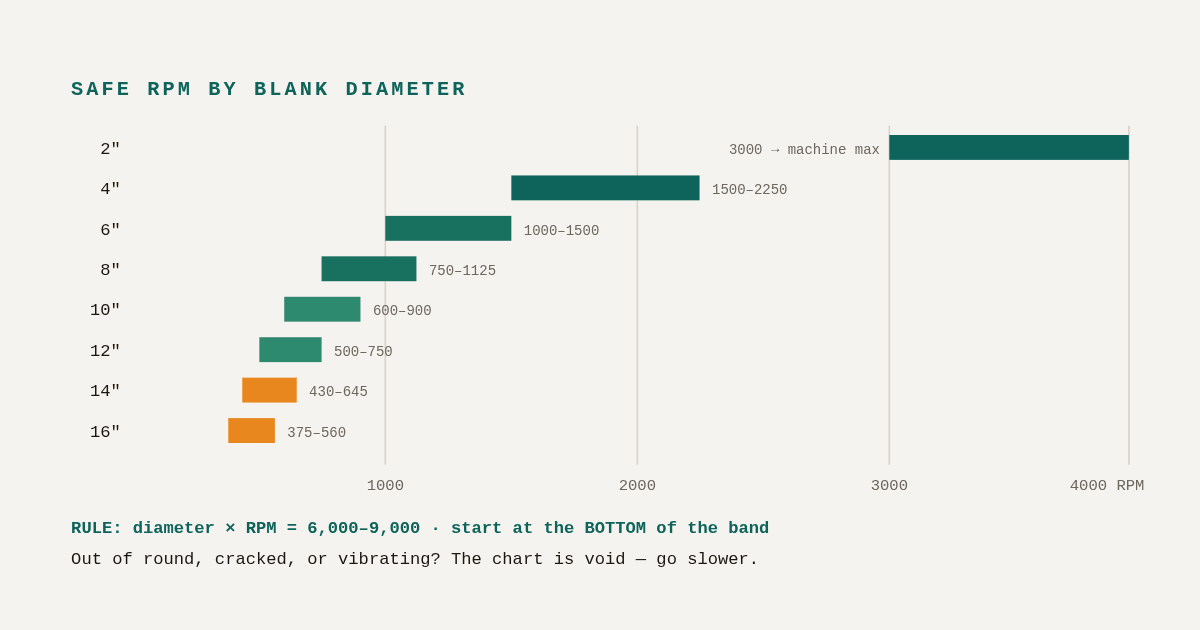
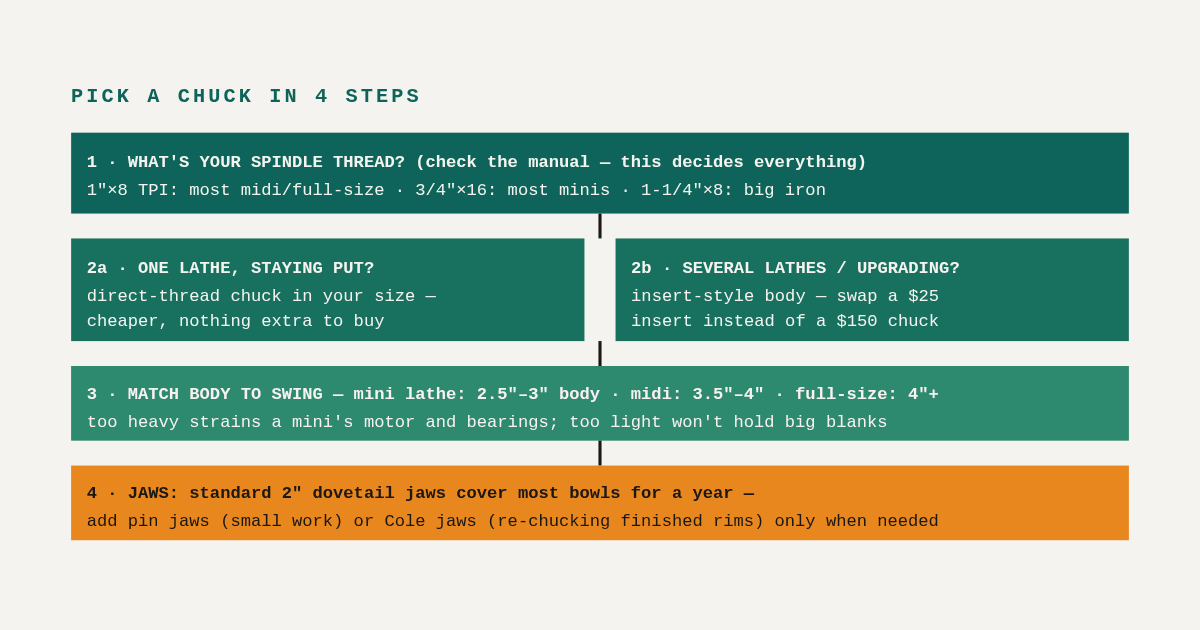
One more green-wood note for the safety file: wet blanks are heavy and often unbalanced - start them slow, and creep the speed up only as the blank comes round (the lathe speed calculator computes that reduced starting speed for out-of-round and green blanks). If you're still choosing a machine for this kind of work, low-speed behavior and mass are exactly what our bowl lathe guide ranks by; the process itself, from mounting to finishing, is in the bowl turning guide.
FAQ
How long does a rough-turned bowl take to dry? Two to six months is typical for a 10%-wall rough-out stored indoors out of direct sun - thicker walls, wetter species, and humid climates take longer. The scale is the honest answer: when monthly weigh-ins stop changing, it's ready.
Can you turn a green bowl and finish it the same day? Yes, if you turn it thin (≤1/4", even) and accept that it will move - that's the once-turned natural-form approach. What you can't have is same-day and stays-perfectly-round.
Why did my green blank crack while drying? Almost always uneven or too-fast moisture loss: unsealed end grain, walls of uneven thickness, or storage somewhere hot and dry (a car trunk in summer kills more rough-outs than any defect). Seal the end grain, aim for even walls, and dry slow and cool.
Is firewood okay to turn? Some of the best free blanks there are - fresh-split rounds of maple, cherry, or birch are exactly what bowl turners hunt. Skip pieces with existing checks through the pith, and remember the pith itself almost always cracks: orient blanks so it's cut away.
Does microwave-drying wood blanks work? It's a real technique for small rough-outs: short low-power bursts with cooling rests, repeated until the weight stabilizes. It saves months but scorches or case-hardens blanks when rushed - practice on scrap before trusting a keeper to it.