6 Best Wood Laser Cutters: From First Diode to Desktop CO2
Affiliate disclosure: As an Amazon Associate, WoodyMan Reviews earns from qualifying purchases. If you buy through links on this page, we may earn a commission at no extra cost to you. How this works.
"Best laser cutter" is really three different questions, because the market splits into three tiers: open-frame diode (cheap, capable, needs respect), enclosed diode (Class 1 safety, living-room compatible), and CO2 (the step change - cuts clear acrylic, engraves faster, goes thicker). This guide picks the standout machine at each rung of that ladder, so you can find your tier and stop reading.
One spec rule before the list: brands headline machine watts; the number that cuts wood is optical output. Every wattage below is optical.
We earn a small commission from the Amazon links below, at no extra cost to you - see our affiliate disclosure. Picks are compared on optical specs, materials range, software ecosystem, and owner-community consensus - we haven't bench-tested them ourselves; how we review.
The 6 best wood laser cutters
| Laser Cutter | Tier / Best for | Woody Rating | |
|---|---|---|---|
| 1. xTool S1 20W | Best overall - enclosed, powerful, safe | 9.4/10 [Editor's Choice] | Check price |
| 2. OMTech Polar Lite 55W | Best desktop CO2 - no workshop needed | 9.1/10 | Check price |
| 3. xTool D1 Pro 10W | Best starter - open-frame value king | 9.0/10 | Check price |
| 4. OMTech 50W CO2 | Most cutting machine per dollar | 8.9/10 | Check price |
| 5. Creality Falcon2 12W | Budget cutting power | 8.8/10 | Check price |
| 6. Glowforge Pro HD | The appliance - easiest possible workflow | 8.4/10 | Check price |
1. xTool S1 20W - Editor's Choice
Best for: the serious hobbyist or side-business - enclosed Class 1 safety, a big bed, and enough diode power that most owners never feel the ceiling.
The S1 is what the diode category grew up into: a fully enclosed machine (Class 1 - the enclosure is the safety system, no goggles needed in normal use) with five flame sensors, a lid-open cutoff, and a 23.9"×15.2" bed that takes real project panels. The 20W module cuts 10mm cherry in a single pass and engraves at up to 600mm/s, and xTool's accessory line - rotary for tumblers, riser kit, the 1064nm infrared module that engraves bare metal - turns it into a small production platform over time. It costs several entry machines' worth, but it replaces the "buy cheap, outgrow it, buy again" cycle with one purchase.
| Pros | Cons |
|---|---|
| ✅ Class 1 enclosed - safest diode workflow | ❌ Priciest diode here |
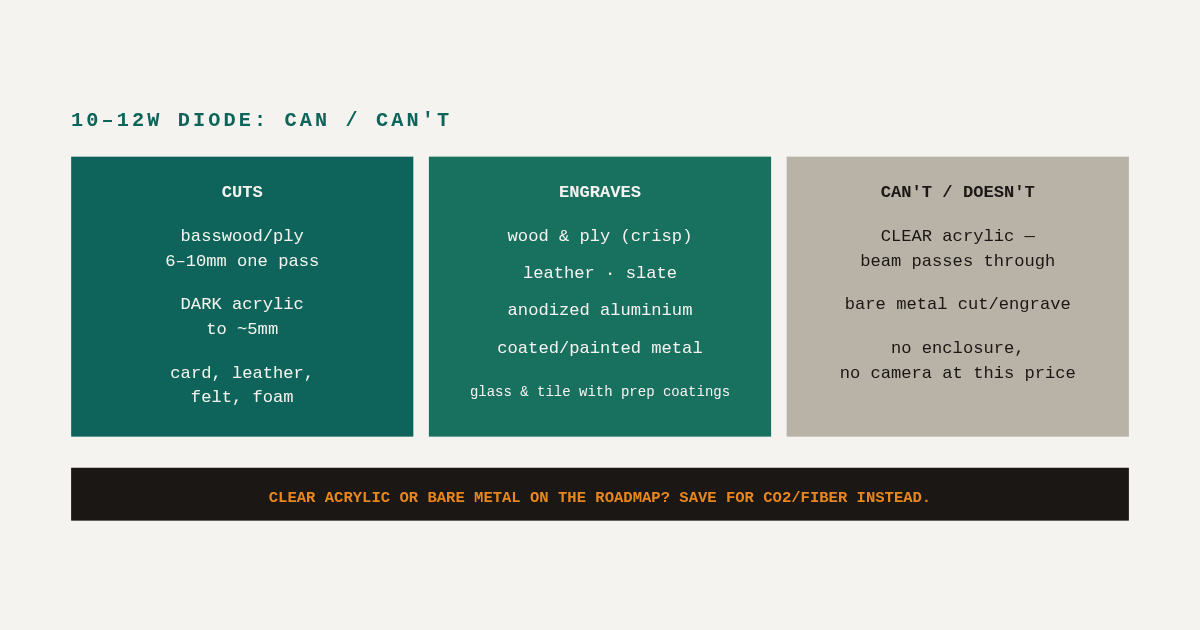
| ✅ 20W: 10mm hardwood in one pass | ❌ Still can't cut clear acrylic (diode physics) |
| ✅ Huge bed + rotary/IR-module upgrade path | |
| ✅ 5 flame sensors, lid cutoff, emergency stop |
2. OMTech Polar Lite 55W - Best Desktop CO2
Best for: crossing the diode/CO2 line without converting your garage - clear acrylic, fast deep engraving, in a machine that sits on a desk.
CO2 is the real step change in laser work: it cuts clear acrylic (diode beams pass straight through it), engraves organics several times faster, and pushes through thicker stock all day. The Polar Lite packages a 55W CO2 tube into a desktop form factor with built-in exhaust fans and a self-contained 0.5-gallon water tank - the two pieces of infrastructure (venting and cooling) that normally make CO2 a workshop commitment. 20"×12" work area, LightBurn-friendly. For makers selling acrylic-and-wood products, this is where the business case starts.
| Pros | Cons |
|---|---|
| ✅ Real CO2: clear acrylic, fast engraving | ❌ CO2 tubes are consumables (years, but finite) |
| ✅ Built-in exhaust + water tank - no plumbing | ❌ Heavier and bulkier than any diode |
| ✅ Desktop footprint, Class 1 enclosure |
3. xTool D1 Pro 10W - Best Starter
Best for: the first laser - the best-built open-frame diode, now at a fraction of its launch price.
Everything in our under-$500 guide applies here: steel-shaft rails that keep accuracy at 400mm/s, flame and tilt sensors, the class's best accessory ecosystem, and one-pass cuts in 6-8mm basswood from the 10W module. As the entry point on this list it has one job - teach you whether laser work sticks for you without a painful bill - and it does that while remaining a machine you'll keep using even after a bigger one arrives (open frames handle oversized stock the enclosed machines can't swallow).
| Pros | Cons |
|---|---|
| ✅ Best build quality of the open frames | ❌ Open frame = Class 4: goggles + ventilation, always |
| ✅ Huge price drop since launch | ❌ Air assist sold separately |
| ✅ Keeps its place even after you upgrade |
4. OMTech 50W CO2 - Most Machine per Dollar
Best for: the workshop user who wants maximum cutting capability for the money and doesn't mind the machine looking industrial.
OMTech's classic blue-and-white 50W is the honest workhorse of budget CO2: 12"×20" bed, Ruida controller, ships with LightBurn, engraves to 10mm depth and runs at 600mm/s. Unlike the Polar Lite you'll set up proper venting to a window and mind the water cooling (pump included; treat the tube kindly and it lasts years). What you get for that setup effort is more work area and more cutting authority than anything else near its price - this class of machine is what half the Etsy laser shops you've bought from actually run.
| Pros | Cons |
|---|---|
| ✅ Serious CO2 capability at diode-adjacent money | ❌ Needs real venting + cooling care |
| ✅ Ruida controller + LightBurn included | ❌ Industrial fit-and-finish |
| ✅ 2-way pass-through for long stock |
5. Creality Falcon2 12W - Budget Cutting Power
Best for: the tightest budget that still wants to cut, not just engrave.
The Falcon2 12W earns its place with integrated air assist and 12W optical output - 10mm basswood in one pass - at an aggressively low street price. It's the "most cutting per dollar" pick of the open frames; pair it with LightBurn and cheap ply and it will out-produce machines that cost double a few years ago. Full detail in our under-$500 roundup.
| Pros | Cons |
|---|---|
| ✅ 12W + built-in air assist at a budget price | ❌ Weak first-party software - get LightBurn |
| ✅ Mostly pre-assembled | ❌ Open frame: Class 4 discipline required |
6. Glowforge Pro HD - The Appliance
Best for: the person who wants results, not a hobby-within-a-hobby - camera positioning, filtered exhaust, and a genuinely press-print workflow.
The Glowforge Pro HD is a 45W Class 1 CO2 with the smoothest workflow in consumer lasers: drop material in, the camera shows it on screen, drag your design onto the live image, print. The HD bundle's Performance Filter means no window venting at all - the only machine here that's truly apartment-ready. Trade-offs are real and worth stating plainly: the software is cloud-based (no internet, no laser), Proofgrade materials are convenient but premium-priced, and you pay a large premium over the OMTechs for the polish. For classrooms, shared studios and non-tinkerers, that polish is exactly the product.
| Pros | Cons |
|---|---|
| ✅ Easiest workflow in the industry (camera + cloud) | ❌ Cloud-dependent software |
| ✅ Filter bundle: no window venting needed | ❌ Big premium over equivalent wattage |
| ✅ 45W CO2, Class 1, pass-through slot (Pro) |
Diode vs CO2: the only comparison that matters
| Diode (xTool, Creality) | CO2 (OMTech, Glowforge) | |
|---|---|---|
| Cuts clear acrylic | ❌ never | ✅ cleanly |
| Wood cutting depth | 6-10mm/pass (10-20W) | 10mm+/pass, faster |
| Engraving speed on wood | good | 2-4× faster |
| Footprint & upkeep | small, minimal | bigger; tube + cooling care |
| Entry price | ~$150 | ~$300 (used K40) / $600+ (real) |
Rule of thumb: hobby and wood-only → diode; selling products or touching acrylic → CO2. For the full materials/settings/safety background, see our complete wood laser guide, the under-$1000 tier, and our dedicated CO2 engraver roundup.
Frequently asked questions
What laser power do I need to cut wood? For 3mm ply/basswood: any 5W+ diode. For 6-10mm: 10-20W diode or any CO2. For hardwoods above 10mm, thick acrylic, or production speed: CO2, 50W up.
Why can't diode lasers cut clear acrylic? Physics - diode wavelengths (~455nm, visible blue) pass through transparent materials instead of being absorbed. CO2's 10,600nm infrared is absorbed by almost everything organic, clear acrylic included.
Is a laser cutter for wood cheaper than a CNC router? At entry level, yes - capable diodes start around $150 vs $400+ for a usable CNC (see our CNC router vs mill explainer). They complement rather than compete: lasers win on detail and speed in sheet goods; CNC wins on depth, 3D carving and joinery.
How long do laser modules and tubes last? Diode modules: typically 8,000-10,000+ hours if kept clean and cool. CO2 glass tubes: 1,500-6,000 hours depending on quality and how hard you drive them - a consumable you replace for ~$100-250.
Do I need LightBurn? If your machine isn't a Glowforge: effectively yes. It's ~$60, runs everything GRBL and Ruida on this page, and is the single best money-per-frustration-saved purchase in the hobby.
Verdict
Find your tier: starting out → xTool D1 Pro (or the Falcon2 12W to maximize cutting on a budget). Committed hobbyist → xTool S1 and never think about goggles again. Making money or cutting acrylic → OMTech Polar Lite on a desk, the OMTech 50W in a workshop, or the Glowforge Pro HD if workflow beats spec sheets for you.