How to Bid a Drywall Job: A Step-by-Step Estimating Guide
Bidding a drywall job comes down to answering three questions accurately: how much material, how much labor, and how much do I mark it up to make a profit? Underbid and you lose money; overbid and you lose the job. This guide walks the estimate step by step so your numbers are right - whether you're a DIYer pricing your own basement or a pro writing a client quote.
The core method is simple: measure the area, translate it into materials and labor, then add overhead and profit. Let's build it up.
Step 1: Measure the square footage
Drywall is estimated by square feet of surface to be covered - walls and ceilings.
- Walls: multiply each wall's length × height, and add them up. For a room, a shortcut is (perimeter × ceiling height).
- Ceilings: length × width of each ceiling.
- Openings: for small jobs, don't subtract doors and windows - the waste and cutting offset them. On big jobs, subtract large openings (garage doors, big windows) so you don't overbuy.
Add everything for total square footage. This one number drives the whole estimate.
Step 2: Count sheets and materials
A standard drywall sheet is 4 × 8 ft = 32 sq ft (sheets also come 4x10 and 4x12 for fewer seams on big walls).
- Sheets needed = total sq ft ÷ 32, then add ~10-15% for waste and cuts.
- Joint compound (mud): roughly one 4.5-gallon box per ~475 sq ft for taping and coats (more for higher finish levels).
- Joint tape: about the same linear footage as your seams - budget a roll or two per few hundred square feet.
- Screws: ~1 lb per ~300-400 sq ft.
- Corner bead: measured by the linear foot of outside corners.
- Primer: don't forget it - bare drywall needs primer before paint.
Price each from your supplier and total the materials cost.
Step 3: Price the labor - and know the finish level
Labor is usually the biggest line, and it depends heavily on the level of finish the job requires. The industry uses Levels 0-5:
- Level 0-1: no finishing or minimal - garages, above ceilings.
- Level 2: tape embedded, one coat - behind cabinets, in garages.
- Level 3: two coats - surfaces getting heavy texture.
- Level 4: three coats, sanded smooth - the standard for most walls taking flat/eggshell paint or light texture.
- Level 5: a skim coat over everything - the highest finish, for glossy paint or raking light (costs the most labor and mud).
Labor covers hanging (installing the board), taping/mudding, and sanding/finishing. Price it one of two ways:
- Per square foot: a single rate covering hang + finish (common for whole jobs). Higher finish levels command a higher rate.
- Per sheet or per hour: some crews price hanging per sheet and finishing separately.
Estimate the hours or square-foot rate for the finish level, multiply by your labor cost, and total it.
Step 4: Add overhead and markup
Your bid isn't just materials + labor. Add:
- Overhead: the costs of being in business - insurance, vehicle, tools, fuel, dumpster/disposal, permits. Spread as a percentage across jobs (often 10-20%).
- Profit markup: what you actually earn, on top of covering costs - commonly 15-30% depending on your market and the job's difficulty.
A rough formula:
Bid = (Materials + Labor) × (1 + overhead % + profit %)
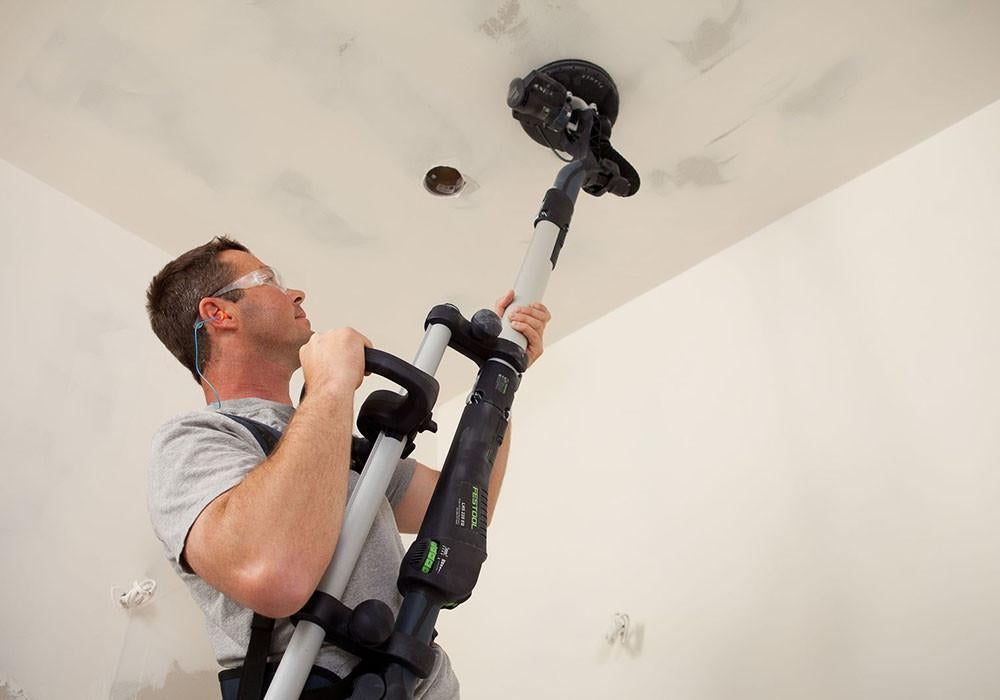
Sanding creates a lot of dust and takes real time at Level 4-5 - factoring the right tools into your overhead pays off. A dedicated dust-extracting drywall sander speeds finishing and cuts cleanup, which protects your labor estimate.
Worked example
Say a room totals 1,200 sq ft of walls and ceiling, finished to Level 4:
- Sheets: 1,200 ÷ 32 = 37.5, +15% waste ≈ 43 sheets.
- Materials: sheets + mud + tape + screws + corner bead + primer. Suppose that totals $900.
- Labor: at, say, $1.75/sq ft for hang-and-finish at Level 4 → 1,200 × $1.75 = $2,100.
- Subtotal: $900 + $2,100 = $3,000.
- Overhead + profit at 30% combined → $3,000 × 1.30 = $3,900 bid.
(These rates are illustrative - use your own local material prices and labor rates.)
Tips to write a winning bid
- Walk the site first. High ceilings, tricky angles, repairs, and access all add labor - see them before you price.
- Be specific in the quote. List the finish level, what's included (and not - e.g., painting), and material allowances. Vague bids cause disputes.
- Don't win by underbidding. The cheapest bid that loses money isn't a win. Price to profit, and sell your quality and reliability.
- Add a contingency for repairs or surprises on remodels, where existing conditions are unknown.
- Track your actuals. After the job, compare real hours and material use to your estimate, and refine your rates for next time.
Frequently Asked Questions
How much does drywall cost per square foot to install?
Installed drywall (hang and finish to Level 4) commonly runs a few dollars per square foot including materials and labor, but it varies widely by region, finish level, and ceiling height. Build your own number from local material prices plus your labor rate rather than relying on a national average.
How do I calculate how many sheets of drywall I need?
Total the square footage of walls and ceilings, divide by 32 (a 4x8 sheet), and add 10-15% for waste and cuts. For big walls, 4x10 or 4x12 sheets reduce the number of seams to tape.
What is a Level 4 vs Level 5 drywall finish?
Level 4 is three coats of mud over tape, sanded smooth - the standard for most painted walls. Level 5 adds a full skim coat over the entire surface for the smoothest result, needed under gloss paint or in raking light. Level 5 costs noticeably more in labor and mud.
Should I include painting in a drywall bid?
Only if the client asks - state clearly whether your bid includes priming and painting or ends at finished, primed drywall. Many drywall bids stop at a primed Level 4 surface and leave finish painting to a separate trade or line item.
Related guides
Finishing drywall well means controlling dust and sanding smooth - see our best sander for drywall picks. Working with wood on the same remodel? Browse our wood sanders hub and wood paint guide. Turning your trade into a brand? Get naming ideas in our woodworking business names guide.